
Why Your Family Medical Card May Be Putting Your Family At Risk

TL;DR:

- A “family” medical card usually means a shared annual limit — not separate cover per person
- A single 4-person dengue episode can absorb RM60,000–RM80,000 of a typical RM150,000 family limit
- Age-band repricing jumps 50–100% when the oldest child crosses 18–21
- BNM’s September 2024 co-payment mandate adds cumulative cost most families don’t model
- High-deductible parent + zero-deductible child is the strategy that actually works
Your family’s “one-policy” medical card has a single weakest link: a shared annual limit. When a coverage year starts, the limit is the limit — no matter how many family members get sick.
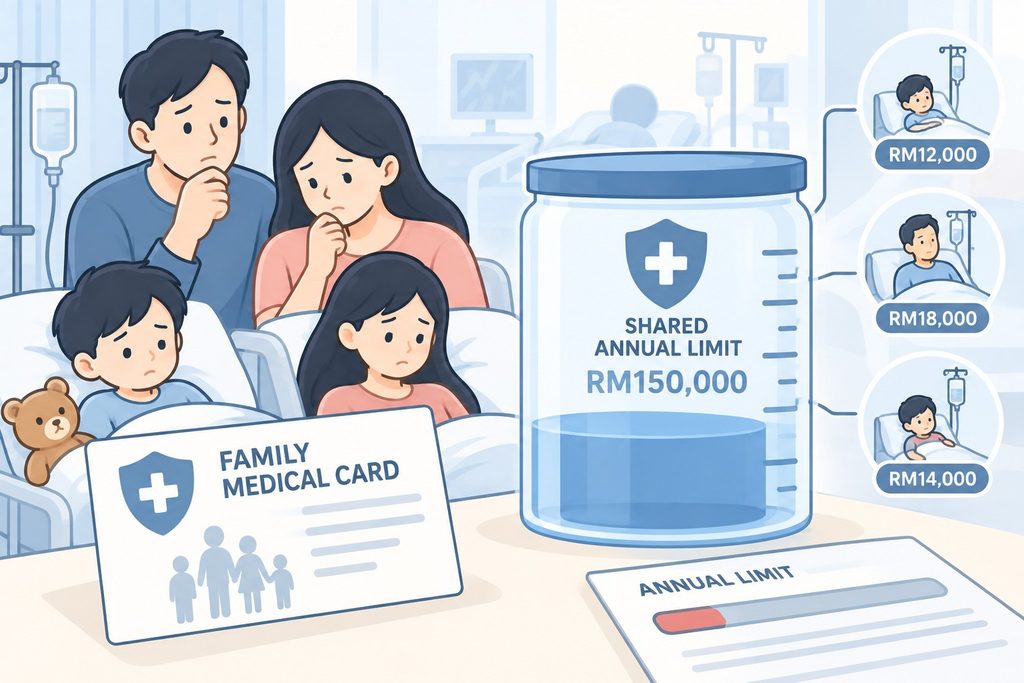
Picture a family of four — parents aged 45 and 47, two children aged 10 and 13. They share a single family medical card with a RM150,000 annual limit. Premium: RM850/month, cheaper than four individual policies. The label “family” feels reassuring.
March: the younger child is admitted for dengue fever. Five-day hospital stay, RM12,000 covered. April: the father catches dengue during the recovery window. Two-week treatment including monitoring, RM18,000 covered. May: the elder child tests positive. RM14,000. The mother avoids it — but only by luck, not by design.
By June, the family has spent RM44,000 on dengue alone. The remaining RM106,000 must last the next nine months for any unrelated medical event across all four members. If the father suffers a heart attack requiring RM80,000 of cardiac care, the limit drops to RM26,000 with seven months to go. If anything serious happens after that — to anyone in the family — the bill is fully out of pocket. The “family” medical card has, by mid-year, become effectively worthless for everyone but the youngest, healthiest member.

The Shared Annual Limit Trap
Most family medical cards in Malaysia offer a single annual limit shared across all named insured members. Typical ranges:
- Entry-level family plan: RM100,000–RM150,000 shared limit
- Mid-tier family plan: RM200,000–RM300,000 shared limit
- Premium family plan: RM500,000 shared limit (rare, expensive)
These limits look generous in isolation. They become inadequate quickly when one family member’s medical event consumes a disproportionate share. Common scenarios that exhaust family limits:
- Multiple dengue episodes in one year (RM60,000–RM80,000 for a family of four)
- Single cardiac event requiring surgery + ICU (RM60,000–RM100,000)
- Cancer treatment including surgery, chemo, and follow-up (RM80,000–RM150,000 in first year alone)
- Long pediatric ICU stay for chronic condition (RM15,000–RM35,000 per year, indefinite)
Any one of these can leave the family under-covered for the rest of the year. The math problem compounds because the “family” card doesn’t prorate or refund — the limit is the limit, and once it’s spent, it’s gone.

Why Individual Policies Cost Less Than They Look
The pitch for family medical cards is straightforward: cheaper premium, simplified administration, one renewal date. The pitch is correct on the first two points. The third is a marketing simplification. Here’s why individual policies often look more expensive but aren’t:
| Strategy | Typical monthly premium (family of 4) | Effective coverage |
|---|---|---|
| Single family medical card (shared RM150K limit) | RM800–1,200 | RM150K shared (4 people) |
| 4 individual policies (separate RM150K limits each) | RM1,000–1,500 | RM600K effective (4 × RM150K) |
| Hybrid: 2 parents on individual + 2 children on individual | RM900–1,300 | RM600K effective + better per-member underwriting |
| High-deductible parent policies + zero-deductible child policies | RM900–1,300 | Variable; ~RM500K effective for predictable members, RM150K+ per child |
The premium difference is often 10–20% — about RM150–250 per month for a typical Malaysian family of four. For 10–20% more premium, you get 4× the effective coverage. Over a year, the additional cost is RM1,800–RM3,000. Over the same year, a single major medical event could easily cost RM50,000–RM80,000 more out of pocket on the family plan than on individual policies. The math favors the more expensive option almost every time.
The Age-Band Repricing Trap
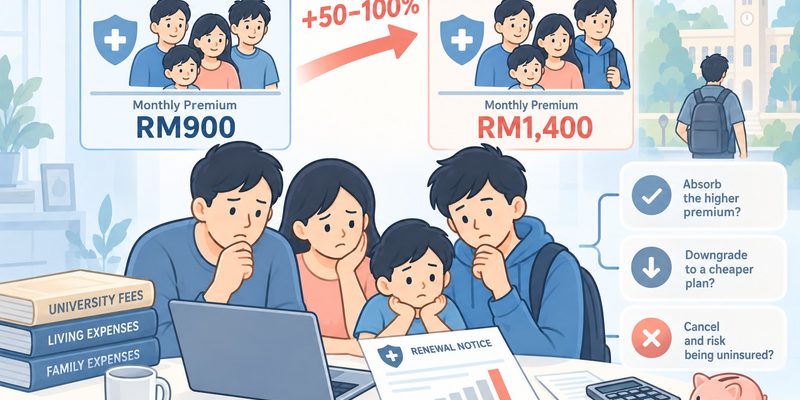
Most family medical plans reprice at renewal based on the age of the oldest insured member. The cliff between bands creates a specific trap: when the eldest child enters the 18–21 age band, premium jumps 50–100% in a single renewal.
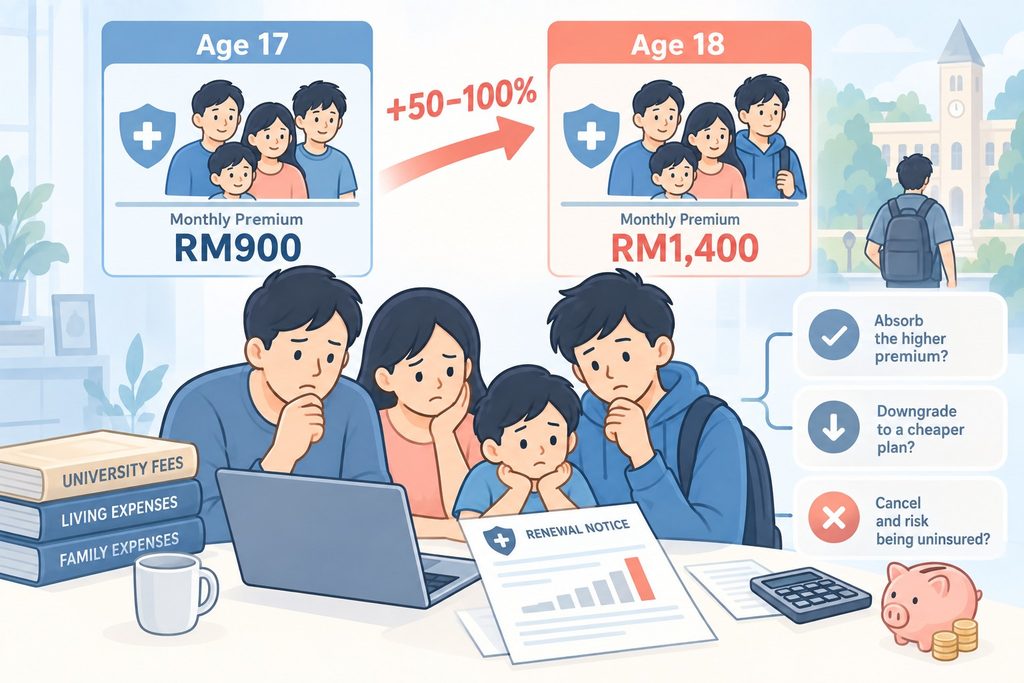
This isn’t a slow escalation families can budget for. It’s a step change. A plan costing RM900/month at child age 17 might renew at RM1,400/month at child age 18. Most families experience this shock once — at exactly the time they’re also paying university fees, supporting a young adult’s transition, and managing their own mid-40s health insurance costs.
The repricing trap pushes many families into a corner: absorb the doubled premium, downgrade to a cheaper plan with worse coverage, or cancel entirely and hope nothing happens during the uninsured window. None of these is a good outcome. Individual policies don’t escape repricing (everyone ages), but the upward trajectory is smoother and the per-member jump is smaller.
BNM’s September 2024 Co-Payment Mandate
Bank Negara Malaysia issued new rules on co-payment structures for medical insurance in September 2024. The intent was prudent: discourage over-utilisation, slow premium inflation, encourage policyholders to be conscious consumers of healthcare. The implementation adds layers most families don’t model into their annual budgets.
Under the new framework, policies with low premiums typically carry higher co-payments at the point of claim. A 5% co-payment on a RM50,000 procedure is RM2,500 out of pocket. Over a year with three such events, cumulative co-payments can hit RM5,000–RM8,000 — and these come ON TOP of the policy limit, not within it.
For families already pushing against the shared annual limit, co-payments are pure additional cost. A working paper from BNM’s Financial Stability Review notes that under-co-payment cumulative impact is one of the leading drivers of family medical plan dissatisfaction in 2024–2025. Most advisors are flagging this in policy sales; families who bought before the mandate may be discovering it at claim time.

The Strategy That Works: High-Deductible Parent + Zero-Deductible Child
- Parents carry high-deductible individual medical cards: RM5,000–RM10,000 deductible, RM300,000+ annual limit. Premium drops 35–50%. Parents’ healthcare needs tend toward planned procedures (cardiac, orthopaedic, screening) that can be timed to maximise deductible efficiency.
- Children carry zero-deductible individual medical cards: full coverage, smaller annual limit (RM100,000–RM150,000 is enough for most paediatric needs). Children have higher frequency of acute events (respiratory infections, accidents, fevers) where a deductible creates friction.
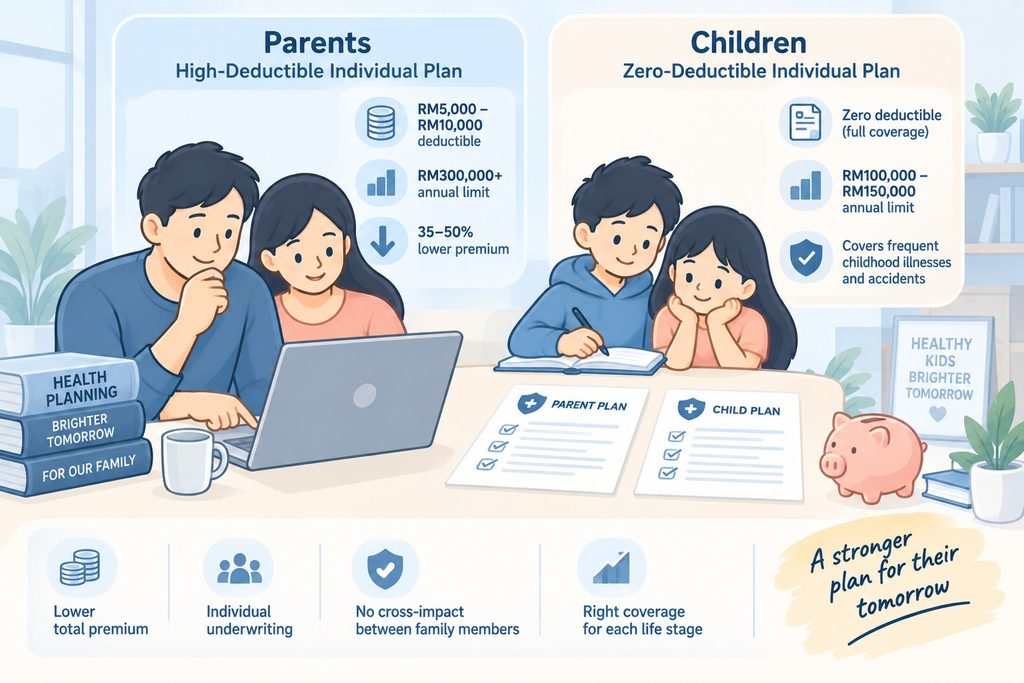
The math: parents save RM200–400/month each on premiums, sacrificing only the routine small claims. Children get full coverage for the events that are most frequent and most disruptive to working parents. Combined monthly premium is often LESS than a single family medical card with the same effective coverage tier.
The structural advantage is that each family member’s underwriting is independent. A diagnosis for one parent doesn’t affect the other’s coverage or premium. A child’s pre-existing condition doesn’t trigger loading across the whole family. Renewal history stays clean for each member. The “family” stays together in concept while the risk pool stays segmented where it should be.
Frequently Asked Questions
What is a shared annual limit on a family medical card?
A single annual cap on total claimable expenses across all insured members on the policy. If the family of four has a RM150K shared limit and one member’s care consumes RM80K, only RM70K remains for everyone else for the rest of the year.
Are individual policies always more expensive than family plans?
Typically 10–20% more in monthly premium for the same coverage tier. The trade-off is 4× effective coverage (separate limits per person). For most families, the math favours individual policies.
What is BNM’s co-payment mandate about?
BNM issued rules in September 2024 requiring co-payment on medical insurance claims to discourage over-utilisation. Co-payments typically range from 0–10% of claim amount and are paid by the policyholder on top of any policy limits.
When does the age-band repricing trap hit?
Most family medical plans reprice when the oldest insured member crosses 18–21. Premiums can jump 50–100% at this renewal. Individual policies reprice more gradually as each member ages.
Is the high-deductible parent + zero-deductible child strategy right for everyone?
Not universally. It works best for families with predictable parental healthcare (planned procedures, monitoring) and higher-frequency paediatric care (acute events, common childhood conditions). Your advisor should model both strategies against your specific family risk profile.
Can I switch from a family plan to individual policies mid-term?
Generally you must wait for the family plan’s annual renewal. At renewal, you can cancel the family plan and apply for individual policies. Each individual application requires its own health disclosure and underwriting.
Our Take
Here’s my honest take: the “family” label feels reassuring but obscures the real math. A family medical card is cheaper upfront because the insurer is pooling risk across predictable ages — and hoping that no single member’s event consumes a disproportionate share of the limit. When that hope fails, the family discovers too late that they were never properly insured for the worst-case scenario.
For most Malaysian families, individual policies with separate limits cost 10–20% more but deliver four times the effective coverage. The math favours the more expensive option almost every time, especially when you factor in BNM’s recent co-payment mandate and the age-band repricing cliff waiting at child age 18. The strategy isn’t a one-size-fits-all prescription — families with very different risk profiles will optimise differently. But the default assumption that “family” means “better” deserves a closer look before every renewal.
The best time to model individual policies is during the family plan’s renewal window — that gives you headroom to switch before repricing hits. The second-best time is today. The worst time is after a major claim has wiped out the shared limit.
Insurance is a complex product with terms that vary by provider. This article discusses considerations, not endorsements. We’re not currently licensed financial advisors — consult a BNM-registered advisor before making coverage decisions specific to your situation.
The Rest of This 5-Part Series
This article is Part 4 of 5 in a series on Malaysian family financial planning. The rest of the series:
- Part 1: Maternity Insurance in the First 30 Days: Why Waiting Until Delivery Leaves Your Newborn Uninsurable — The 14-day grace window for newborn coverage and why a prenatal rider on a maternal ILP is the most direct mechanism to bridge the gap.
- Part 2: Why Relying on Your Company Medical Card Is the Costliest Bet for Malaysian Parents — Group Hospitalization cover feels free but ends the day your last pay slip ends — and the high-deductible private bridge that backstops it.
- Part 3: A Medical Card Pays the Hospital. Who Pays Your Mortgage? The Critical Illness Blind Spot — How Critical Illness insurance covers what a medical card can’t — your mortgage, school fees, and household burn rate during recovery.
- Part 5: The Payor Waiver Clause: How to Ensure Your Child’s Policy Outlives Your Income — The Payor Benefit Rider that keeps a child’s policy alive if the parent dies, and Schedule 10 of FSA 2013 — the Statutory Trust that protects minor’s proceeds.
Sources
- Bank Negara Malaysia (BNM) — financial regulator and licensing body for insurers and takaful operators
- BNM List of Licensed Insurers — verify any provider before purchasing
- BNM Financial Stability Review (FSR) 2025H2 — systemic risk assessment across Malaysia’s financial system, including insurance sector
- Persatuan Insurans Am Malaysia (PIAM) — general insurance industry association
- Malaysian Takaful Association (MTA) — takaful industry association
- Financial Services Act 2013 (FSA 2013) — primary legislation for Malaysian insurance
About the author: Hoo is the founder of HelloExpress.net. He was a BNM-registered takaful agent earlier in his career; that license is no longer active. His coverage of Malaysian family financial planning draws on this background, but he is not currently licensed to provide financial advice. For coverage decisions, consult a BNM-registered advisor.