

Maternity Insurance in the First 30 Days: Why Waiting Until Delivery Leaves Your Newborn Uninsurable

TL;DR:

- A newborn’s first 14 days are covered automatically under the mother’s policy — but the safety net cliffs at Day 30
- KKM NICU at Hospital Kuala Lumpur runs perpetually full — neonatal transfer to a private hospital runs RM5,000–RM20,000 out of pocket
- Phototherapy for jaundice alone runs RM800–RM1,500/day at private hospitals; most courses last 3–5 days
- A prenatal rider on a maternal investment-linked policy (ILP), attached between weeks 13 and 36 of pregnancy, extends coverage through the Day 30 cliff
- Insurance is a complex product with provider-specific terms — consult a BNM-registered advisor before locking anything in

Your newborn’s first cry is also the sound of an insurance window most parents don’t know exists.
In the next 14 days, your baby could develop jaundice requiring phototherapy — RM800 to RM1,500 per day at a private hospital. They could be admitted to NICU for prematurity, infection, or respiratory distress — RM5,000 to RM20,000 per stay. They could be born with a congenital heart defect requiring surgery in the first month of life.
If any of these happen — and statistically, they happen to roughly one in seven Malaysian newborns — your baby now has a pre-existing condition on file. The medical card you’d planned to apply for at Day 31? It will exclude those conditions for life, or load your premiums permanently. That’s the trap. And most parents don’t know it exists until they’re already inside it.
The 14-Day Safety Net
Most Malaysian insurance products include a grace window for newborns. When a mother holds an active policy — whether a medical card, ILP, or maternity rider — the insurer automatically extends coverage to her newborn for the first 14 days of life.

During this window, every complication matters. Neonatal jaundice. Phototherapy. Congenital heart defects discovered at birth. All covered without health disclosure. No underwriting. No exclusions for pre-existing conditions. This is the only period in your child’s life when insurance is genuinely unconditional.
If you’re a parent reading this who’s already past week 36, the window for a prenatal rider has closed — but you still have a fallback. Apply for your baby’s medical card on Day 1, not Day 31. Most insurers accept applications from Day 1 if the mother is already a policyholder; the underwriting gap only opens after the cliff.
The Day 30 Cliff
The grace window ends quietly. On Day 30, the mother is typically discharged from post-natal follow-up, and the policy’s automatic newborn extension terminates. From Day 31 onwards, your baby is uninsured unless a standalone policy has been issued.
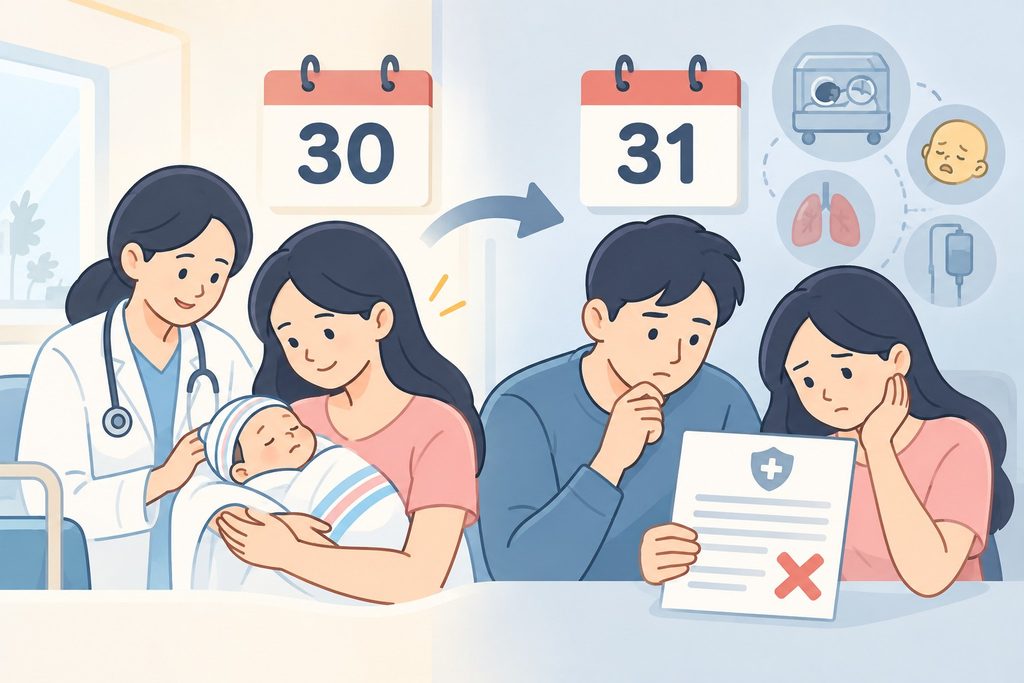
For parents who planned to apply for a medical card “after things settle down” — usually around Week 6 to Week 8 post-delivery — this is where the trap springs.
The standard paediatric medical card application requires full health disclosure. That includes any conditions diagnosed or treated in the first 30 days of life. Jaundice? Phototherapy? Respiratory distress? Brief NICU stay? All of it goes on the baby’s permanent medical record.
The Underwriting Trap
A newborn with a 14-day history of phototherapy is not the same underwriting risk as a healthy newborn with a clean first month. Insurers can:
- Load the premium — charge 30–80% more than the standard rate for the life of the policy
- Exclude specific conditions permanently — typically jaundice, respiratory, or any NICU-related diagnosis
- Decline the application outright — rare but possible, especially for congenital conditions
The “wait until after birth” approach creates a permanent record of vulnerability before coverage even starts. And once exclusions are written into a policy, they’re nearly impossible to remove at renewal.
What a Prenatal Rider Actually Does
A prenatal rider is an add-on to a maternal investment-linked policy (ILP) that extends newborn coverage from the moment of birth — without underwriting the baby separately.
| Element | How it works |
|---|---|
| Eligibility window | Attach the rider during weeks 13–36 of pregnancy |
| Coverage trigger | Automatic at birth, regardless of baby’s condition |
| Underwriting | Done on the mother (existing policyholder), not the baby |
| Coverage scope | Typically includes congenital conditions, NICU, phototherapy, life cover for 30–90 days |
| Premium structure | Add-on to existing ILP premium (typically RM50–200/month incremental) |
The key advantage: the underwriting risk is transferred to the mother’s existing policy. The baby is born already covered, with no health declaration required at any point. Coverage bridges seamlessly through the Day 30 cliff and into a permanent standalone policy if desired.
The KKM NICU Reality
Why this matters now: Malaysia’s public healthcare system delivers world-class neonatal care, but capacity is finite.
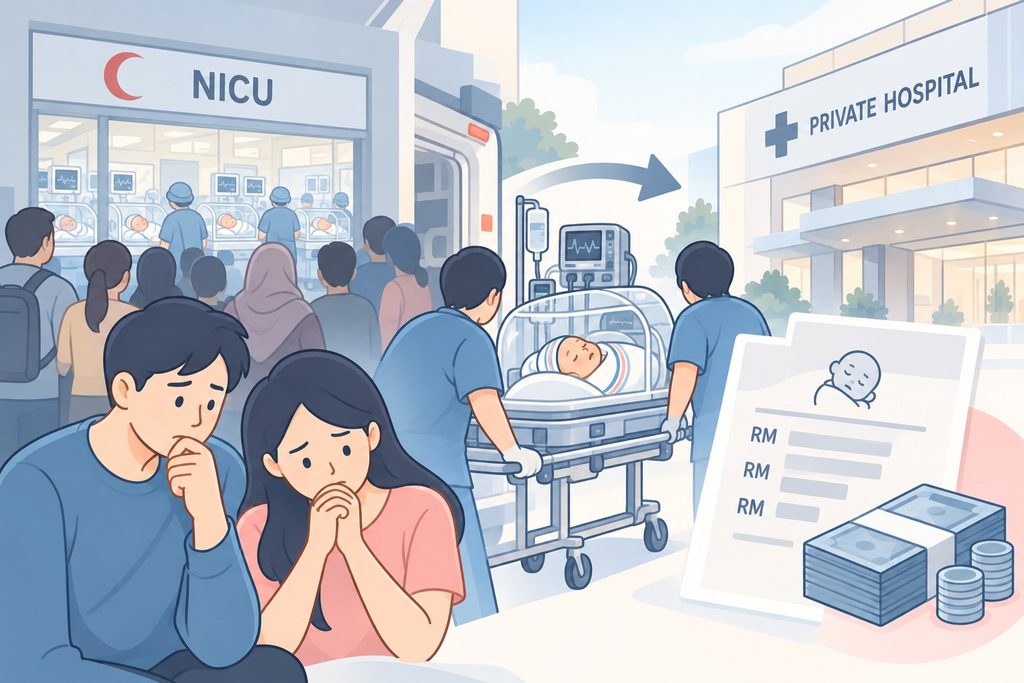
- The KKM NICU at Hospital Kuala Lumpur runs perpetually full, accepting only the most critical cases through triage
- This isn’t unique — it’s the public system reality at every major KKM facility
- When overflow happens, neonatal transfers go to private hospitals
- Transfer costs fall entirely on parents who haven’t pre-arranged coverage
Every parent who delivers at a KKM facility is one bed-availability crisis away from a transfer to a private hospital. RM5,000 to RM20,000 per transfer, out of pocket. Phototherapy — the most common newborn complication — runs RM800 to RM1,500 per day at private hospitals. Most courses last 3 to 5 days. That’s RM2,400 to RM7,500 before you’ve even left the maternity ward.
Cost Comparison: Wait vs. Pre-Plan
| Scenario | Coverage status at Day 31 | Out-of-pocket exposure |
|---|---|---|
| Wait until after birth, no coverage | None | RM5,000–RM20,000+ (NICU) + RM2,400–RM7,500 (phototherapy) |
| Wait until after birth, medical card declined | None | Full cost of all treatment |
| Wait until after birth, medical card loaded | Loaded premium + permanent exclusions | RM800–RM1,500/day (phototherapy), full cost of excluded conditions |
| Prenatal rider, attached during pregnancy | Covered from birth through Day 30 cliff | RM0 (subject to policy terms) |
The math isn’t subtle. A rider premium of RM50–200/month is two orders of magnitude cheaper than a single NICU day at a private hospital. And unlike NICU exposure, the premium is a known, capped cost.

Frequently Asked Questions
When can I attach a prenatal rider?
Most Malaysian insurers allow attachment between weeks 13 and 36 of pregnancy. Some providers have narrower windows. Discuss timing with your advisor early in the second trimester.
Does the rider cover congenital conditions?
Coverage varies by product. Some riders cover congenital conditions diagnosed within a specific window (typically 30–90 days post-birth); others exclude them entirely. Read the policy schedule carefully before signing.
What if my baby is born premature?
Premature birth is typically covered under prenatal riders — the whole point of the structure is to cover newborns regardless of condition. Verify coverage limits with your specific policy.
Can I attach the rider without an existing ILP?
Most prenatal riders are add-ons to maternal ILPs. Standalone prenatal products exist but are less common in Malaysia. You’ll typically need to take out a maternal ILP first.
What if I miscarry after attaching the rider?
Some riders return premiums or extend cover to a future pregnancy. This is product-specific — read the contract terms carefully before attaching.
I missed the prenatal window — what now?
Apply for your baby’s medical card on Day 1 of life, not Day 31. Most insurers accept applications from Day 1 if the mother is already a policyholder. The underwriting gap only opens after the Day 30 cliff.
Our Take
Here’s my honest take: insurance is sold after the risk is known, and newborns are the highest-risk customers an insurer ever sees. The 14-day grace window isn’t a marketing gift — it’s a structural gap that lets insurers avoid the impossible underwriting question of “what’s wrong with this baby we just met.” That grace window happens to leave parents exposed exactly when they need coverage most.
The prenatal rider exists because someone, somewhere, asked: “What if we did the underwriting on the mother and let the baby start covered?” It’s a real solution to a real problem, not a marketing gimmick. The window is narrow — weeks 13 to 36 of pregnancy — and the cost difference between acting and not acting is roughly two orders of magnitude.
The best time to ask about a prenatal rider is your first prenatal visit. The second-best time is today. If you’ve already passed week 36, don’t wait until Day 31 to apply for your baby’s medical card — start on Day 1, while you’re still inside the grace window.
Insurance is a complex product with terms that vary by provider. This article discusses considerations, not endorsements. We’re not currently licensed financial advisors — consult a BNM-registered advisor before making coverage decisions specific to your situation.
The Rest of This 5-Part Series
This article is Part 1 of 5 in a series on Malaysian family financial planning. The rest of the series:
- Part 2: Why Relying on Your Company Medical Card Is the Costliest Bet for Malaysian Parents — Group Hospitalization cover feels free but ends the day your last pay slip ends — and the high-deductible private bridge that backstops it.
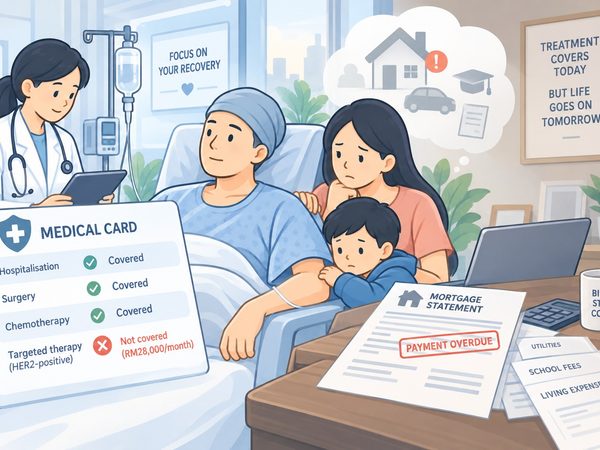
- Part 3: A Medical Card Pays the Hospital. Who Pays Your Mortgage? The Critical Illness Blind Spot — How Critical Illness insurance covers what a medical card can't — your mortgage, school fees, and household burn rate during recovery.
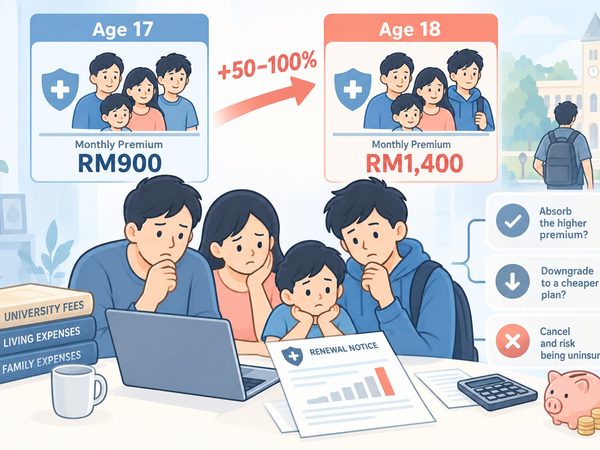
- Part 4: Why Your Family Medical Card May Be Putting Your Family At Risk — The shared annual limit trap, the age-band repricing cliff, and BNM's September 2024 co-payment mandate — and the strategy that actually works.
- Part 5: The Payor Waiver Clause: How to Ensure Your Child's Policy Outlives Your Income — The Payor Benefit Rider that keeps a child's policy alive if the parent dies, and Schedule 10 of FSA 2013 — the Statutory Trust that protects minor's proceeds.
Sources
- Bank Negara Malaysia (BNM) — financial regulator and licensing body for insurers and takaful operators
- BNM List of Licensed Insurers — verify your provider is registered before purchasing
- Persatuan Insurans Am Malaysia (PIAM) — general insurance industry association
- Malaysian Takaful Association (MTA) — takaful industry association
- Ministry of Health Malaysia (KKM) — public healthcare system data and NICU capacity reporting
- Financial Services Act 2013 (FSA 2013) — primary legislation governing Malaysian insurance products
About the author: Hoo is the founder of HelloExpress.net. He was a BNM-registered takaful agent earlier in his career; that license is no longer active. His coverage of Malaysian family financial planning draws on this background and the studies he is making for his new born baby, but he is not currently licensed to provide financial advice. For coverage decisions, consult a BNM-registered advisor.