

The Payor Waiver Clause: How to Ensure Your Child’s Policy Outlives Your Income

TL;DR:

- A child’s education or medical policy can lapse the moment the parent (payor) dies — without a Payor Benefit Rider
- The Payor Benefit Rider waives all future premiums if the payor dies, suffers TPD, or is diagnosed with covered CI
- Schedule 10 of the Financial Services Act 2013 (Statutory Trust) protects minor children’s insurance proceeds from adult financial pressure
- Without a payor waiver, a child’s policy may lapse right when the family needs it most — typically within 30 to 90 days of missed premium
- Education savings (SSPN-i, ASB) complement but don’t substitute for properly structured insurance planning

A father’s life insurance policy pays out. His son’s education policy — the one he set up when his son was born — lapses because no one pays the premium. The lump-sum payout becomes a slow-bleeding corpus, not the structure he planned. By the time the son turns 18, the corpus has been quietly consumed by household expenses, mortgages, and the daily costs of being a single-parent family.
The father’s planning didn’t fail at the moment of death. It failed years earlier, when the education policy was set up without a Payor Benefit Rider. The premium waiver he never added costs the family the structure he thought he’d built. This is one of the most common — and most preventable — gaps in Malaysian family financial planning.
What Happens When the Payor Dies
Most insurance products require ongoing premium payments to remain in force. The payor — typically the parent whose income funded the premium — is the policy’s lifeline. Three events terminate that lifeline:
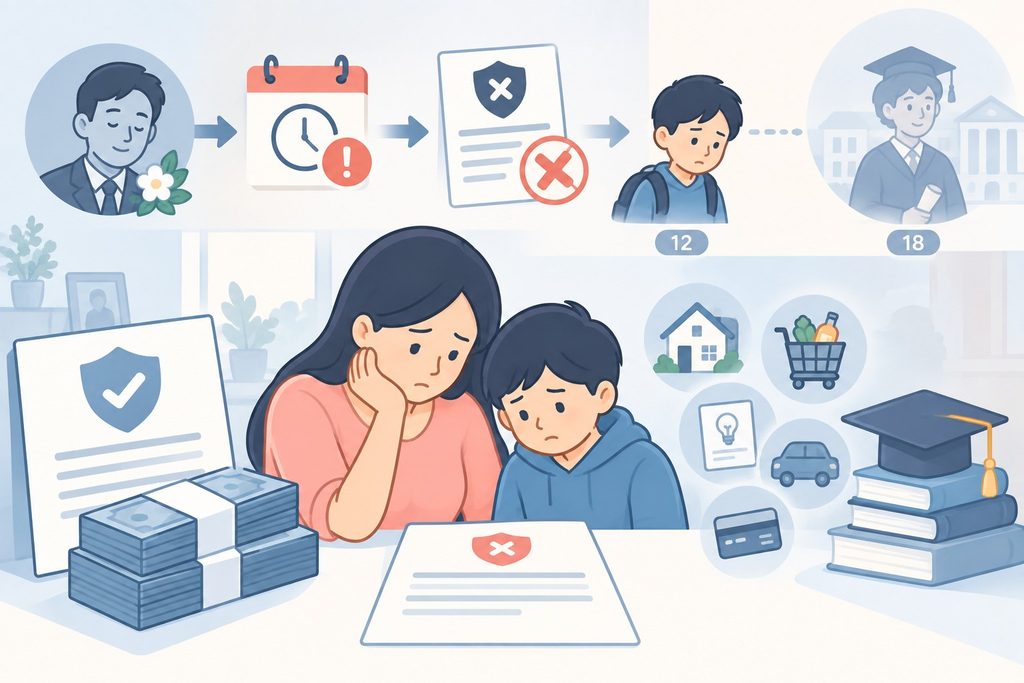
- Payor death: the policy is in force until the next premium due date. If no one pays, the policy lapses within a 30 to 90 day grace window. Most insurers send reminders to named beneficiaries, but those reminders require someone to act on them — and the family is often in crisis mode during this period
- Payor Total Permanent Disability (TPD): same outcome. TPD typically triggers life insurance payouts but doesn’t auto-extend to other policies the payor covers
- Payor Critical Illness (CI) diagnosis: depends on policy wording, but most education and medical policies don’t include CI as a premium-waiver trigger unless a Payor Benefit Rider was added at issue
For working-age parents, the most common scenario is death during the child’s minority. The education policy was meant to mature when the child turned 18, paying for university. If it lapses at age 12 because the payor died at age 42, the structure collapses six years short of its goal. The lump-sum life insurance payout may be large, but it’s a single event — and it’s now being consumed by ongoing household expenses rather than growing toward the child’s education.

The Payor Benefit Rider
The Payor Benefit Rider is an add-on to most child-linked insurance policies — education plans, child medical plans, child life cover — that converts the policy’s vulnerability to payor death into a guaranteed structure.

| Element | Without Payor Benefit Rider | With Payor Benefit Rider |
|---|---|---|
| Trigger events | None — premium must be paid continuously | Payor death, TPD, or covered CI |
| Premium obligation after trigger | Continues — must be paid by someone | Waived — insurer absorbs |
| Policy status after payor death | Lapses within 30 to 90 days | Remains in force to maturity |
| Premium loading | None | Typically 5 to 15% of base premium |
| Cost-benefit analysis | Cheaper upfront, structurally fragile | Modest additional cost, structural guarantee |
The cost of the rider is small relative to the cost of the structure failing. A RM200 per month education plan with a 10% rider costs RM220 per month. The same RM20 per month uplift is the difference between a policy that protects the child’s future come what may and a policy that depends on continued payor income to survive.
The most common rider variants cover payor death, TPD, and CI. Some newer riders extend to accidental death and certain defined critical conditions. Read your specific policy schedule to understand the full trigger list. Coverage gaps in the rider can create real exposure when claims are filed.
Schedule 10 of FSA 2013: The Statutory Trust
When an insurance policy insures the life of a minor (under 18) in Malaysia, the proceeds are governed by Schedule 10 of the Financial Services Act 2013. The proceeds must be paid into a Statutory Trust and held by a Trustee until the child reaches the age of majority.
Schedule 10 exists because Parliament recognised that lump-sum payouts made directly to grieving families often get absorbed into household expenses rather than reaching their intended beneficiary — the child. Common pattern: father dies, life insurance pays RM500,000, the family uses it to pay off the mortgage, replace the car, and cover six months of expenses. By the time the child turns 18, the original RM500,000 is gone and there’s nothing left for university.
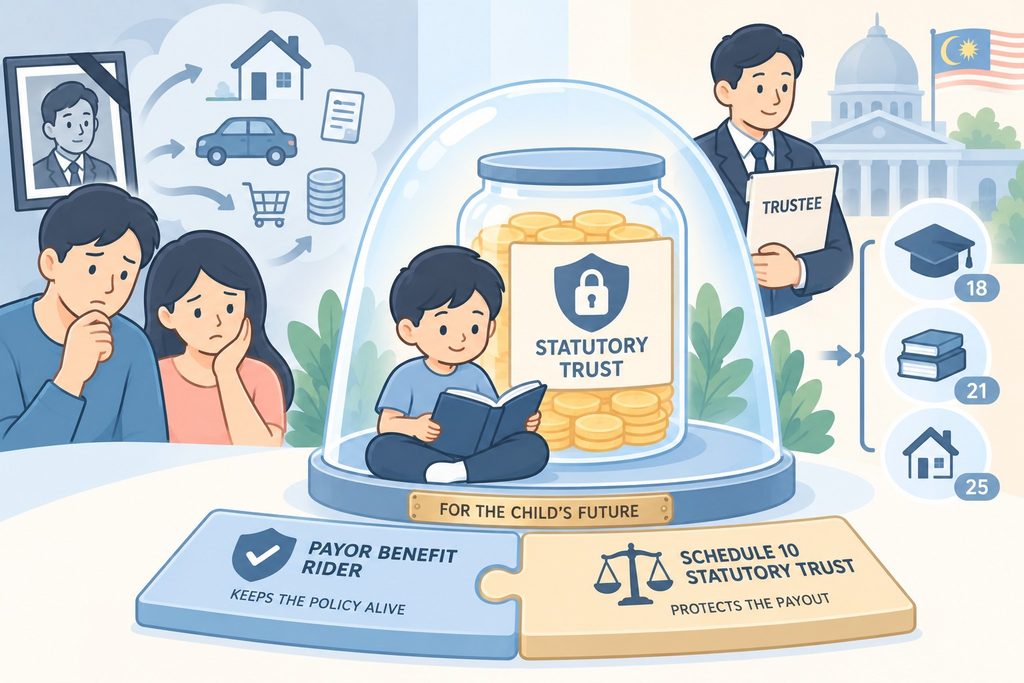
The Statutory Trust structure prevents this. The proceeds are ringfenced, invested by the Trustee, and released to the child only at specified ages (typically 18, 21, 25) or for specified purposes (education, healthcare, housing). The Trustee is bound by the trust deed — which can be customised but is restricted to acting in the child’s interest.
Critical point: Schedule 10 protects the payout when it happens, but it does NOT protect the policy from lapsing. If the policy lapses before the payout triggers, there’s nothing to pay out. The Payor Benefit Rider and Schedule 10 work together — the rider keeps the policy alive, Schedule 10 protects the eventual payout.

Education Savings Complements (Not Substitutes)
Insurance isn’t the only vehicle Malaysian parents use for education planning. Three government-backed savings vehicles often appear alongside insurance in family financial plans:
- SSPN-i (Skim Simpanan Pendidikan Nasional): tax-advantaged education savings up to RM8,000 per year in tax relief, available to all Malaysians. Withdrawable for education purposes
- ASB (Amanah Saham Bumiputera): long-term equity investment, traditionally offered to Bumiputera. Dividend-paying, with low-cost entry. Liquidity constrained but strong long-term returns
- Tabung Haji: Shariah-compliant savings. Lower returns than ASB but accessible for hajj planning
These savings vehicles serve a different function than insurance. They handle the “what if I live” scenario — building wealth gradually through contributions and investment returns. Insurance handles the “what if I die (or become disabled)” scenario — providing a lump sum at exactly the moment it’s needed.
Best practice isn’t choosing one. It’s structuring both. A typical Malaysian parent’s education plan: RM200 to RM500 per month in SSPN-i for accumulation, plus a RM100 to RM300 per month education insurance policy with a payor waiver rider for catastrophic protection. Total outflow is modest, structural integrity is high.
Estate Continuity and the Probate Bypass
Insurance payouts have a structural advantage over estate assets: they bypass probate. When a policy has a named beneficiary, the insurer pays directly to that beneficiary on proof of death — typically within 30 to 60 days. No court involvement, no executor fees, no waiting on the will.
The contrast with estate assets is stark. Property, bank accounts, investments, and EPF balances without named beneficiaries all flow through the deceased’s estate — and estates in Malaysia take 6 to 18 months to clear probate, longer if there’s a will dispute, and even longer if there isn’t. During that period, the family may need liquidity precisely when insurance is supposed to provide it.
This is why named beneficiaries matter. Every policy should have them. Every EPF nomination should be current. Every bank account should have a joint holder or named beneficiary where the structure allows. Schedule 10 doesn’t solve probate delays — it solves the more specific problem of protecting minor’s proceeds once they’ve been paid.

When Education Insurance Alone Isn’t Enough
Education insurance products are designed around standard scenarios — child reaches 18, payout triggers, covers a local degree at a public university. That structure breaks at the edges:

- Overseas tertiary education: UK, US, and Australia degrees cost RM200,000 to RM500,000 and up. Most Malaysian education policies mature at RM50,000 to RM100,000 — covering 1 to 2 years of a local degree, not a full overseas program
- Postponed milestones: child turns 25, still studying, no payout triggered yet at age 18. Many policies mature at age 18 specifically, locking the schedule
- Multiple children: a single education policy covers one child. Families with multiple children need multiple policies, multiplying the cost (and structural risk if the payor waiver isn’t on all of them)
- Special educational needs: most policies exclude or limit coverage for children with disabilities diagnosed before policy inception. Pre-existing conditions in newborns are a major disclosure issue
For families with international education ambitions, savings vehicles (SSPN-i, ASB, unit trusts) are essential complements. Insurance is the floor — it covers the catastrophic scenario where the payor dies. Savings are the ceiling — they fund the upside scenarios where the child has options.
Frequently Asked Questions
What is a Payor Benefit Rider?
An add-on to a child-linked insurance policy that waives all future premiums if the payor (parent) dies, suffers Total Permanent Disability (TPD), or is diagnosed with a covered Critical Illness (CI).
How much does a Payor Benefit Rider cost?
Typically 5 to 15% of the base policy premium. A RM200 per month policy might cost RM210 to RM230 per month with the rider added.
What is Schedule 10 of the FSA 2013?
The statutory framework under the Financial Services Act 2013 that requires insurance proceeds for minors to be held in a Statutory Trust by a Trustee until the child reaches the age of majority.
Does Schedule 10 protect the policy from lapsing?
No. Schedule 10 protects the payout once it triggers. The Payor Benefit Rider is what keeps the policy alive if the payor dies. They serve different but complementary functions.
Are SSPN-i and ASB substitutes for education insurance?
No. They serve different functions. SSPN-i and ASB are savings vehicles for the “what if I live” scenario. Insurance is a protection product for the “what if I die” scenario. Most well-structured plans use both.
Can I add a Payor Benefit Rider after the policy is issued?
Some insurers allow it during specific renewal windows or qualifying events. Adding the rider at policy issue is cleanest and typically has the most favourable underwriting terms.
Our Take
Here’s my honest take: the Payor Benefit Rider isn’t an upsell. For any parent setting up a child-linked insurance policy — education, medical, or life — it is a structural requirement, not an optional add-on. Without it, the entire policy is contingent on the payor’s continued employment, continued health, and continued survival. The 5 to 15% premium uplift is the cost of converting that contingency into certainty.
The gap is more common than it should be because the rider is rarely explained at the point of sale. Insurance agents often lead with the headline premium, then add riders that don’t get the full walkthrough. Parents sign up thinking they have a complete structure, only to discover years later that a single missed premium payment — caused by the worst day of their family’s life — has collapsed the entire plan. Schedule 10 of the FSA 2013 exists precisely because Parliament recognised that minor children’s insurance proceeds need protection from adult financial pressures. The Payor Benefit Rider completes that protection at the front end of the policy.
If you already have a child-linked policy, check the schedule for a Payor Benefit Rider clause. If it’s there, you’ve covered the structural risk. If it’s not, ask your insurer about adding it. The conversation costs 15 minutes. The protection costs less than RM50 per month. The downside of not having it is measured in the kind of family outcomes no parent wants to imagine.
Insurance is a complex product with terms that vary by provider. This article discusses considerations, not endorsements. We’re not currently licensed financial advisors — consult a BNM-registered advisor before making coverage decisions specific to your situation.
The Rest of This 5-Part Series
This article is Part 5 of 5 in a series on Malaysian family financial planning. The rest of the series:
- Part 1: The First 30 Days: Why Waiting Until Delivery Leaves Your Newborn Uninsurable — The 14-day grace window for newborn coverage and why a prenatal rider on a maternal ILP is the most direct mechanism to bridge the gap.
- Part 2: Why Relying on Your Company Medical Card Is the Costliest Bet for Malaysian Parents — Group Hospitalization cover feels free but ends the day your last pay slip ends — and the high-deductible private bridge that backstops it.
- Part 3: A Medical Card Pays the Hospital. Who Pays Your Mortgage? The Critical Illness Blind Spot — How Critical Illness insurance covers what a medical card can't — your mortgage, school fees, and household burn rate during recovery.
- Part 4: Why Your Family Medical Card May Be Putting Your Family At Risk — The shared annual limit trap, the age-band repricing cliff, and BNM's September 2024 co-payment mandate — and the strategy that actually works.
Sources
- Financial Services Act 2013 (FSA 2013) — primary legislation governing Malaysian insurance, including Schedule 10 (Statutory Trust for minors)
- Bank Negara Malaysia (BNM) — financial regulator and licensing body for insurers and takaful operators
- BNM List of Licensed Insurers — verify any provider before purchasing
- Persatuan Insurans Am Malaysia (PIAM) — general insurance industry association
- Malaysian Takaful Association (MTA) — takaful industry association (Islamic equivalent structures)
- Lembaga Hasil Dalam Negeri (LHDN) — tax treatment of education insurance premiums and SSPN-i contributions
About the author: Hoo is the founder of HelloExpress.net. He was a BNM-registered takaful agent earlier in his career; that license is no longer active. His coverage of Malaysian family financial planning draws on this background, but he is not currently licensed to provide financial advice. For coverage decisions, consult a BNM-registered advisor.