
A Medical Card Pays the Hospital. Who Pays Your Mortgage? The Critical Illness Blind Spot

TL;DR:
- A medical card pays the hospital bill. It does not pay your mortgage while you can’t work
- The 36-month burn rate — typical recovery or end-of-life timeline for major CI — means 36 monthly mortgage payments without an income
- KKM’s drug formulary covers standard chemotherapy, but targeted therapy runs RM15,000–50,000/month out of pocket
- Critical Illness (CI) insurance pays a lump sum on diagnosis — you decide how to spend it
- Term CI vs ILP rider: 2–3x coverage at half the cost, but no cash value accumulation
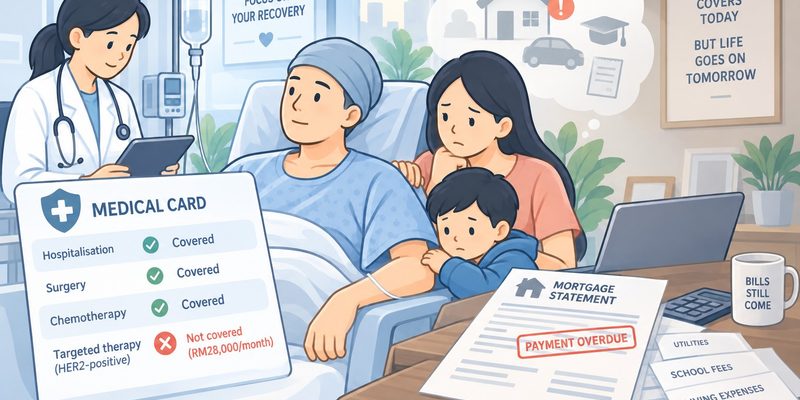
The medical card paid the surgeon’s bill. The chemotherapy was covered by KKM’s drug formulary. The targeted therapy — the one the oncologist actually recommended because the cancer was HER2-positive — was off the formulary, retail-priced at RM28,000/month, billed directly to a household that hadn’t worked for two months. By month six, the family was three payments behind on the mortgage.
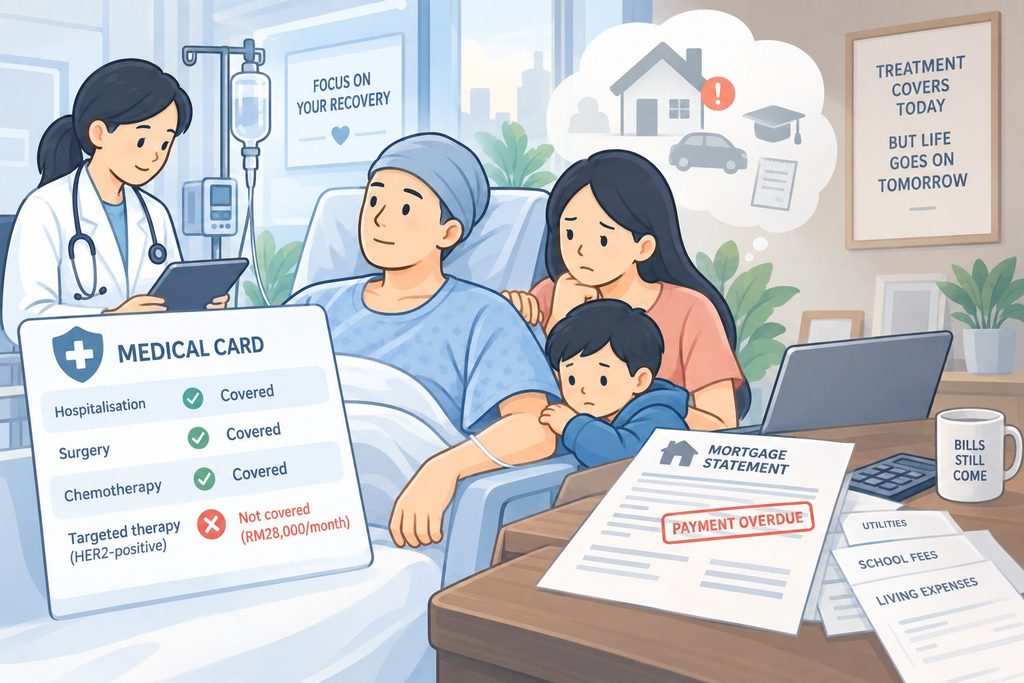
Here’s the trap most Malaysian families don’t see until it’s too late: a medical card pays for treatment. It does not replace your income while you undergo that treatment. If a critical illness takes you out of work for 24, 36, or 48 months, the bills keep coming. The medical card covers most of them. The mortgage doesn’t.
The 36-Month Burn Rate
For most critical illnesses — cancer being the most common — the practical reality of treatment and recovery is a 24–48 month disruption to earning capacity. During those months, the household still has:
- Mortgage: RM2,500–6,000/month for a typical Malaysian family home
- Utilities, groceries, transport: RM3,000–5,000/month
- Children’s school fees + activities: RM1,500–4,000/month
- Ongoing medical co-pays: RM500–2,000/month even with insurance
- Car loan + insurance: RM800–1,500/month
A conservative burn rate is RM8,000–15,000 per month. At 36 months, that’s RM288,000–540,000 of household expenses that don’t pause when your salary does. Most working-age Malaysians have 3–6 months of emergency savings, not 36. The burn rate is what destroys families during the recovery window — not the treatment cost.
What KKM’s Drug Formulary Doesn’t Cover
KKM’s drug formulary is comprehensive for standard, generic chemotherapy. It’s not comprehensive for targeted therapy, immunotherapy, or any of the newer-generation treatments that are now standard-of-care in private oncology practice. Some specific gaps:
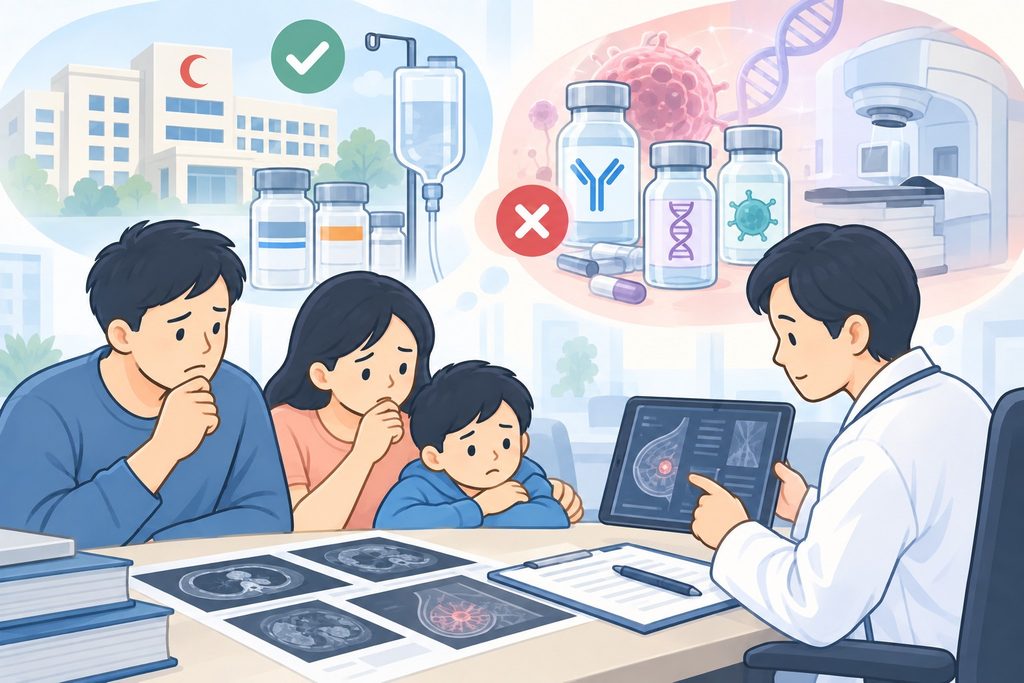
- Targeted therapy (cancer): Trastuzumab (HER2+ breast cancer), Imatinib (CML), Erlotinib (NSCLC) — RM15,000–50,000/month, typically 24+ months
- Immunotherapy: Pembrolizumab, Nivolumab — RM20,000–45,000/month for 12–24 months
- Bone marrow transplant: RM150,000–300,000 total, donor search and procurement add RM50,000–100,000
- Specialist consultations in private sector: RM200–500 per visit, every 2–4 weeks during treatment
These are not optional add-ons. They’re what the oncologist will recommend when standard chemotherapy isn’t sufficient. The KKM alternative is generic chemo with documented lower response rates. Many families end up paying for private care out of pocket because the survival difference is meaningful — and because the medical card pays for inpatient stays but not always outpatient oncology drugs.

How Critical Illness Insurance Fills the Gap
Critical Illness (CI) insurance is a lump-sum payout on diagnosis of a covered condition. The payout isn’t tied to actual treatment cost, hospital bill, or income. It’s yours to spend however the family needs.
Common uses for a CI payout:
- Cover the 24–36 month burn rate (mortgage, school fees, household expenses)
- Pay for off-formulary drugs (targeted therapy, immunotherapy)
- Fund a bone marrow transplant or overseas specialist consultation
- Buy out a family member’s time to be the primary caregiver
- Settle remaining debts (car loan, credit card balances)
- Adapt the home (wheelchair access, medical equipment)
The structural advantage is flexibility. A medical card is a payment channel tied to specific providers. CI is a cheque made out to the policyholder, with no spending restrictions.
Early-Stage vs Advanced-Stage CI Coverage
Modern CI policies have evolved to cover conditions at multiple stages. Understanding the difference matters because the early-stage payout can fund treatment before the disease progresses:
| Feature | Early-stage payout | Advanced-stage payout |
|---|---|---|
| Trigger | Diagnosis at early stage (e.g., carcinoma in situ, early-stage cancer) | Diagnosis at major stage (e.g., invasive cancer, advanced disease) |
| Payout (% of sum assured) | 25–50% | 100% |
| Conditions covered | 3–8 typically (carcinoma in situ, early prostate, mild stroke, etc.) | 30–40 typically (all major cancers, heart attack, stroke, kidney failure) |
| Coverage continues after payout? | Yes (most plans) — reduced sum assured | Varies by plan |
| Strategic value | Fund early intervention, prevent progression | Replace income during major event |
The early-stage payout is the unsung hero of CI planning. A 25–50% payout at early-stage diagnosis often covers the cost of preventing progression — better surgery, more aggressive monitoring, off-formulary drugs. It’s the difference between a successful intervention and an advanced-stage payout two years later.
Multi-Pay Structures: Protecting Against Recurrence
Cancer recurrence is the long tail that standard CI plans don’t cover. After a first payout, you’re back to work, you think you’re done. Then the cancer recurs — and you’re uninsured for the second event. Multi-pay structures exist specifically to handle this scenario:

- Multi-pay CI: Allows 2–3 separate CI claims across different conditions OR recurrence of the same condition after a waiting period (typically 12–24 months cancer-free)
- Restoration benefit: Original sum assured restored after a successful claim, providing fresh cover for the next event
- Total payout cap: Multi-pay plans typically cap at 2–3x the original sum assured over the policy lifetime
For parents with family history of cancer (parents, siblings with cancer diagnoses), multi-pay CI is non-negotiable. Single-event CI leaves you exposed the second time the disease returns. Multi-pay transforms the policy from one-shot protection into ongoing coverage across a treatment journey that often spans decades.

Term CI vs ILP Rider: The Coverage Trade-Off
Two mainstream ways to structure CI coverage in Malaysia, with meaningfully different cost-and-return profiles:
| Element | Standalone Term CI | ILP Rider |
|---|---|---|
| Coverage period | Fixed term (typically to age 65–70) | Life of the ILP (typically to age 70–85) |
| Cash value accumulation | None — pure protection | Yes — investment-linked savings component |
| Payout on maturity | None — expires if no claim | Investment value returned (subject to market performance and charges) |
| Coverage amount per ringgit | 2–3x higher for same monthly premium | Lower — premium split between protection and investment |
| Long-term cost | Predictable, fixed premium | Premium scales with age; investment charges compound |
| Best fit | Maximum protection, minimum complexity | Combined protection + savings, accepting lower coverage ratio |
The pure-math answer: term CI delivers more coverage per ringgit. The behavioural answer: ILP riders force regular premium discipline, which matters for people who wouldn’t otherwise maintain CI cover. There’s no universally right choice — but for a household that has savings vehicles already in place (ASB, EPF, unit trusts), term CI lets those handle the wealth accumulation role while CI handles pure protection.
The Math: Real Numbers
Anchoring the conversation in MYR amounts with two scenarios:
Scenario A: Breast cancer (HER2+), age 42
Diagnosis: early-stage invasive ductal carcinoma, HER2+. Treatment plan: surgery + 12 months Trastuzumab (RM22,000/month) + 6 months chemotherapy.
- Medical card covers: surgery inpatient, generic chemo, hospital stays
- Out-of-pocket exposure: RM264,000 targeted therapy + RM30K specialist consults + RM120,000 income replacement = RM414K over 18 months
- Term CI payout (RM300K sum assured): funds 8 months of targeted therapy, leaves 10 months uncovered
- Term CI payout (RM500K sum assured): funds full treatment + ~12 months burn rate
Scenario B: Colorectal cancer, age 55
Diagnosis: Stage III colorectal cancer. Treatment plan: surgery + 6 months chemo + 12 months oral targeted therapy (RM18K/month) + ongoing surveillance.
- Medical card covers: surgery inpatient, generic chemo, follow-up scans
- Out-of-pocket exposure: RM216K oral targeted therapy + RM60K specialist consults + RM280K income replacement (24 months burn) + RM40K home adaptation = RM596K over 24 months
- Without CI payout: family liquidates ASB + EPF Account 2 + borrows against home
- With RM500K CI payout: ~84% of exposure covered without raiding savings
The numbers aren’t subtle. A RM300–500K CI payout isn’t luxury insurance — it’s the difference between a survivable event and a financial catastrophe that compounds over decades.
Frequently Asked Questions
Does a medical card cover chemotherapy?
Inpatient standard chemotherapy is typically covered by both KKM (fully) and private medical cards (subject to plan limits). Outpatient targeted therapy and immunotherapy are often not covered by medical cards and require separate funding.
How much CI coverage do I need?
Rough rule: 3–5 years of household burn rate (mortgage + school + living + medical co-pays) plus a buffer for targeted therapy. For a typical Malaysian family with RM10–15K monthly burn rate, that’s RM360–900K coverage.
Is there a waiting period for CI claims?
Most CI policies have a 30–90 day waiting period after policy start to prevent anti-selection. Some conditions have longer waiting periods (12–24 months for specific cancers). Read your policy schedule.
Can I claim CI more than once?
Standard CI plans cover one event. Multi-pay plans allow 2–3 separate claims (different conditions or recurrence of the same condition after a waiting period). Verify your policy’s multi-pay terms.
What’s the difference between early-stage and advanced-stage payout?
Early-stage payout is typically 25–50% of sum assured for diagnosis at early stages of covered conditions. Advanced-stage payout is 100% for major-stage diagnosis. Both usually maintain coverage for the remaining conditions.
Is CI insurance worth it if I have EPF and ASB savings?
Yes. EPF and ASB are long-term wealth vehicles, designed for retirement or gradual accumulation. CI is a pure protection product — it converts a small monthly premium into a large lump sum at exactly the moment it’s needed. They serve different purposes.