
Why Relying on Your Company Medical Card Is the Costliest Bet for Malaysian Parents

TL;DR:

- Group Hospitalization & Surgical (GHS) cover feels free — but it ends the day your last pay slip ends
- Resignation, retrenchment, and medical termination are three scenarios where employer cover evaporates overnight
- Once a pre-existing condition strikes, the next insurer’s health declaration picks it up — permanently
- KKM waiting times + drug formulary limits push more Malaysian families toward private care every year
- A high-deductible private medical card as a “bridge”: 30–50% premium savings vs zero-deductible, with lifetime RM300–700K cover common
Your company medical card is a loan, not a gift. The bank is time, and the interest compounds every pay cycle.
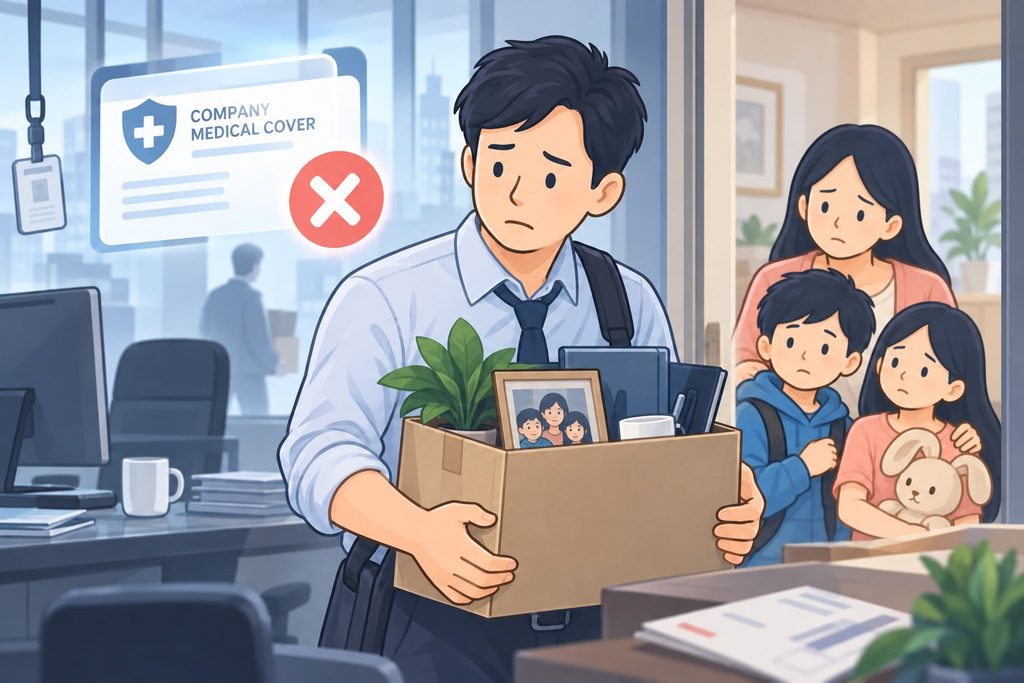
Picture a 47-year-old father of two. He’s had Group Hospitalization & Surgical (GHS) cover through his employer for nine years. Two pre-existing conditions have appeared in his file: Type 2 diabetes, diagnosed at 44, and a herniated disc. Both are managed with medication and lifestyle changes. Both are stable. Both will follow him onto every health disclosure form for the rest of his career.
Then his role gets restructured out. Severance package: three months. COB letter: last day of medical cover is the last day of salary. The 30-day grace window before his next private medical card application requires full health disclosure starts ticking. And that application — the one he should have set up five years ago — just became much more expensive, with permanent exclusions on the conditions he can’t undo.
That scenario plays out thousands of times a year in Malaysia. The “free” employer medical card feels like a benefit. It isn’t. It’s a renewable grace period, contingent on pay slips continuing to clear. The moment they don’t, you’re on your own — and by then, the math has shifted under your feet.
The Three Triggers That End Your “Free” Cover
Employer-sponsored GHS cover in Malaysia typically lasts only as long as your employment contract. Three scenarios end it abruptly:

Resignation
Most policies extend cover for 30 days after your last working day, but that’s a grace window — not ongoing coverage. If you move to a new employer, you might roll straight into their GHS. If you go freelance, retire, or take a career break, you’re exposed from Day 31 onwards.
Retrenchment
Worse than resignation because it’s involuntary. Most employers offer 30 days’ cover during the severance period — and that’s it. The stress of job loss plus the scramble to organise private cover in a 30-day window creates exactly the conditions where rushed health disclosure leads to non-disclosures that come back to bite years later.
Medical termination
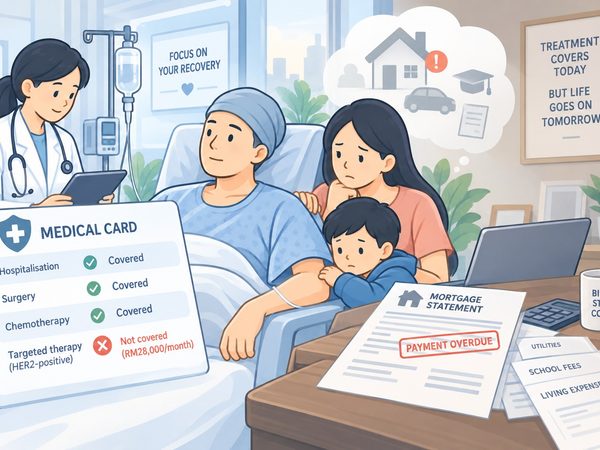
The cruelest scenario. The employee suffers a serious medical event, can’t return to work, and the employer ends the contract. Insurance that was supposed to support recovery evaporates at the moment it’s needed most. The 30-day grace period may not even apply if the termination is immediate. This is the trap that turns manageable conditions into catastrophic financial events.

The Pre-Existing Condition Chain
A standard private medical card application requires full health disclosure. Every diagnosis, every prescription, every specialist visit goes onto the application. The insurer’s underwriting team reviews the file and decides:
- Accept at standard rate — the best outcome, but rare once you’re over 40
- Accept with loading — 30–80% premium uplift for the life of the policy
- Accept with exclusions — permanent exclusions on specific conditions (Type 2 diabetes, hypertension, hyperlipidemia are typical)
- Decline — increasingly common for applicants with multiple conditions
The window between leaving employer A and joining employer B (or starting a private policy) is the danger zone. Any new diagnosis during that window follows you forever. It’s the gap that turns manageable routine care into permanently uninsurable conditions.
When KKM Can’t Carry the Load
The public healthcare system delivers excellent value — RM1 for outpatient, RM5 for specialist consultation, free for citizens in the bottom 40% income bracket. But it operates under structural constraints:
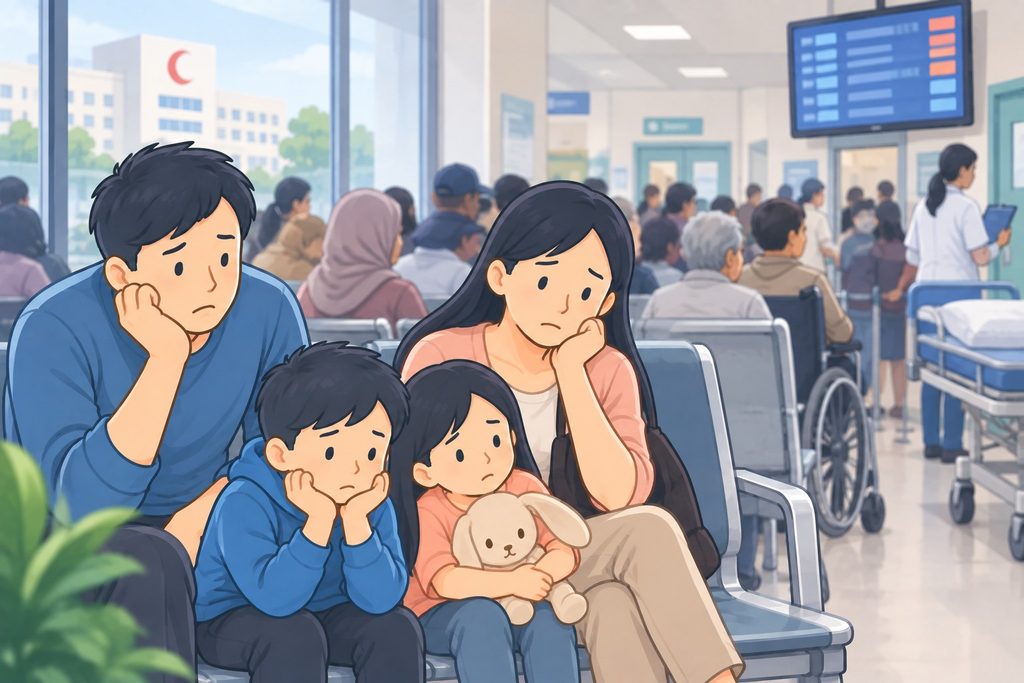
- Waiting times: 4–8 hours for emergency departments at peak; weeks to months for elective procedures
- Drug limits: KKM’s Formulary restricts prescriptions to a defined list of medications. Anything off-formulary is out of pocket, often at full retail price
- Specialist access: limited specialist appointment slots; follow-up care is rationed by urgency, not by patient preference
- Room standards: shared wards (4–6 beds) are the default. Private rooms are rare and prioritised by clinical need
For working-age parents with dependents, the time cost alone — taking two days off work for a non-emergency procedure — is often more expensive than the medical bill. The system is excellent at acute emergencies. It’s not designed for the kind of routine, planned care that working parents actually need.
The Bridge Strategy: High-Deductible Private Medical Card
The strategy isn’t to replace GHS — it’s to backstop it. While you’re employed, you carry a high-deductible private medical card with a smaller annual limit but far lower premium. The deductible (typically RM5,000–10,000) is your buffer; once you cross it, the policy pays up to the annual limit.
| Element | Zero-deductible private | High-deductible private (bridge) |
|---|---|---|
| Monthly premium | RM250–500 | RM120–280 |
| Deductible per year | RM0 | RM5,000–10,000 |
| Annual limit | RM150K–300K | RM300K–700K lifetime |
| Premium savings vs zero-deductible | — | 30–50% |
| Underwriting | Full health disclosure | Full health disclosure |
| Best fit scenario | Single earner, no GHS, predictably healthy | GHS-as-primary + small private buffer |
The math works because most years you never hit the deductible. The 30–50% premium savings buy you a year or two of cover for the moment GHS isn’t there. When employment ends, the bridge is still in force. You don’t face an uninsured 30-day scramble. You face a deductible.
This is also a strategy that works through your 40s, when underwriting gets pickier. A high-deductible policy applied for at 38 with a clean disclosure stays at standard rates through renewals. By the time you reach the medical card application gauntlet in your late 40s or 50s, the high-deductible bridge has years of clean renewal history backing it. Switching to zero-deductible then becomes a renewal upgrade, not a new application with fresh underwriting.
Real Numbers: What the Big Procedures Cost
Anchoring the conversation in MYR amounts makes the difference between covered and catastrophic concrete:
| Procedure | Private hospital (typical range) | What GHS typically covers |
|---|---|---|
| Coronary Artery Bypass Graft (CABG) | RM60,000–90,000 | Often capped or co-pay required |
| Colorectal surgery (cancer) | RM45,000–75,000 | Often capped or co-pay required |
| Pediatric ICU (per year for chronic child) | RM15,000–35,000 | Limited child coverage on adult GHS |
| Cancer — targeted therapy (per month) | RM15,000–50,000 | Off-formulary = no KKM coverage |
| Neonatal NICU (per admission) | RM5,000–20,000 | Subject to triage; private transfers common |
Each row represents the kind of single event that, in a high-deductible scenario, you’d pay out of pocket for the deductible portion (RM5–10K) while the policy covers the rest. In a “no private cover, just GHS” scenario, you’re dependent on GHS still being in force — and on the procedure being within GHS’s coverage scope, which varies widely by employer.

When to Activate Your Zero-Deductible Cover
The bridge isn’t the destination. It’s the planning tool that buys you time and underwriting history. The activation moment is when:

- Your COB (Confirmation of Benefits) letter arrives and your last day of GHS is set
- You decide to leave employment voluntarily (resignation) — start the switch 60 days before your last day
- Your employer announces a restructuring that puts your role at risk
- You reach age 50–55 and want zero out-of-pocket exposure on major procedures
Switching from high-deductible to zero-deductible at that point is typically a renewal upgrade with the same insurer — no fresh underwriting if the renewal is continuous. That’s the value of building underwriting history with one insurer over years. The clean disclosure file you’ve maintained becomes the asset that lets you upgrade on your terms.
Frequently Asked Questions
What is a high-deductible medical card?
A medical insurance policy with an annual deductible (typically RM5,000–10,000) that you pay out of pocket before the policy pays. Premiums are 30–50% lower than equivalent zero-deductible policies.
Does my Group Hospitalization cover me after I leave my job?
Most employer GHS policies extend for 30 days after your last working day. After that, you’re uninsured unless you’ve arranged a private medical card or your new employer offers GHS.
Can I switch from high-deductible to zero-deductible later?
Typically yes, as a renewal upgrade with the same insurer, provided your policy has been continuously renewed. Avoids fresh health disclosure and underwriting.
What happens if I get diagnosed between leaving GHS and starting a private policy?
The diagnosis becomes part of your medical record and must be disclosed on any new medical card application. It will likely result in permanent exclusions or a declined application.
Are KKM Formulary limits the same as private hospital drug lists?
No. KKM’s Formulary covers a defined list of essential medications at no cost. Private hospitals typically prescribe the latest drugs without formulary restrictions, but at retail prices.
Is employer GHS taxable income?
Generally no, when it’s a standard benefit. Specific tax treatment depends on policy structure and your employer’s arrangement with the insurer. Verify with a tax advisor for your situation.
Our Take
Here’s my honest take: employer GHS is one of the most underappreciated financial risks in Malaysian working life. The benefit feels free because there are no premium deductions from your pay slip. But “free” and “yours” are different things. The cover is conditional on continued employment, and the moment that condition fails — through resignation, retrenchment, or worse — you’re standing in the underwriting line with whatever conditions the intervening years have produced.
The bridge strategy isn’t a product recommendation — it’s a planning framework. It says: while you have GHS, also carry a high-deductible private medical card with continuous renewal history. Pay the 30–50% premium uplift as the cost of optionality. When the moment arrives that GHS ends, you’re not scrambling — you’re switching from bridge to zero-deductible on terms you already negotiated.
The best time to set up the bridge is in your late 20s or early 30s, when underwriting is easy and premiums are low. The second-best time is today. The worst time is when you already need it.
Insurance is a complex product with terms that vary by provider. This article discusses considerations, not endorsements. We’re not currently licensed financial advisors — consult a BNM-registered advisor before making coverage decisions specific to your situation.
The Rest of This 5-Part Series
This article is Part 2 of 5 in a series on Malaysian family financial planning. The rest of the series:
- Part 1: The First 30 Days: Why Waiting Until Delivery Leaves Your Newborn Uninsurable — The 14-day grace window for newborn coverage and why a prenatal rider on a maternal ILP is the most direct mechanism to bridge the gap.
- Part 3: A Medical Card Pays the Hospital. Who Pays Your Mortgage? The Critical Illness Blind Spot — How Critical Illness insurance covers what a medical card can't — your mortgage, school fees, and household burn rate during recovery.
- Part 4: Why Your Family Medical Card May Be Putting Your Family At Risk — The shared annual limit trap, the age-band repricing cliff, and BNM's September 2024 co-payment mandate — and the strategy that actually works.
- Part 5: The Payor Waiver Clause: How to Ensure Your Child's Policy Outlives Your Income — The Payor Benefit Rider that keeps a child's policy alive if the parent dies, and Schedule 10 of FSA 2013 — the Statutory Trust that protects minor's proceeds.
Sources
- Bank Negara Malaysia (BNM) — financial regulator and licensing body for insurers and takaful operators
- BNM List of Licensed Insurers — verify any provider before purchasing
- Persatuan Insurans Am Malaysia (PIAM) — general insurance industry association
- Malaysian Takaful Association (MTA) — takaful industry association
- Ministry of Health Malaysia (KKM) — public healthcare system data, drug formulary listings
- Financial Services Act 2013 (FSA 2013) — primary legislation for Malaysian insurance
About the author: Hoo is the founder of HelloExpress.net. He was a BNM-registered takaful agent earlier in his career; that license is no longer active. His coverage of Malaysian family financial planning draws on this background, but he is not currently licensed to provide financial advice. For coverage decisions, consult a BNM-registered advisor.