
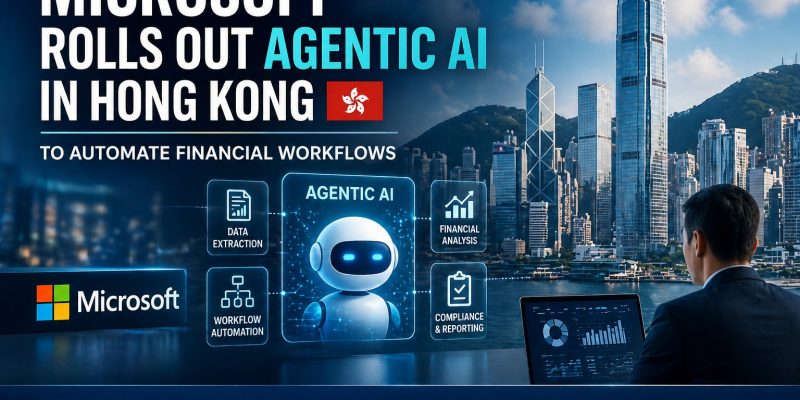
Microsoft Rolls Out Agentic AI in Hong Kong to Automate Financial Workflows

TLDR:

- Microsoft launches its agentic AI suite in Hong Kong, targeting financial and enterprise workflows
- Microsoft 365 E7 (Frontier Suite) reaches general availability on 1 May 2026
- AIA and AS Watson Group among early adopters deploying AI across claims, retail, and productivity
- Microsoft reinforces its 35-year presence in Hong Kong with a focus on responsible AI scaling
Microsoft Brings Agentic AI to Hong Kong Enterprises
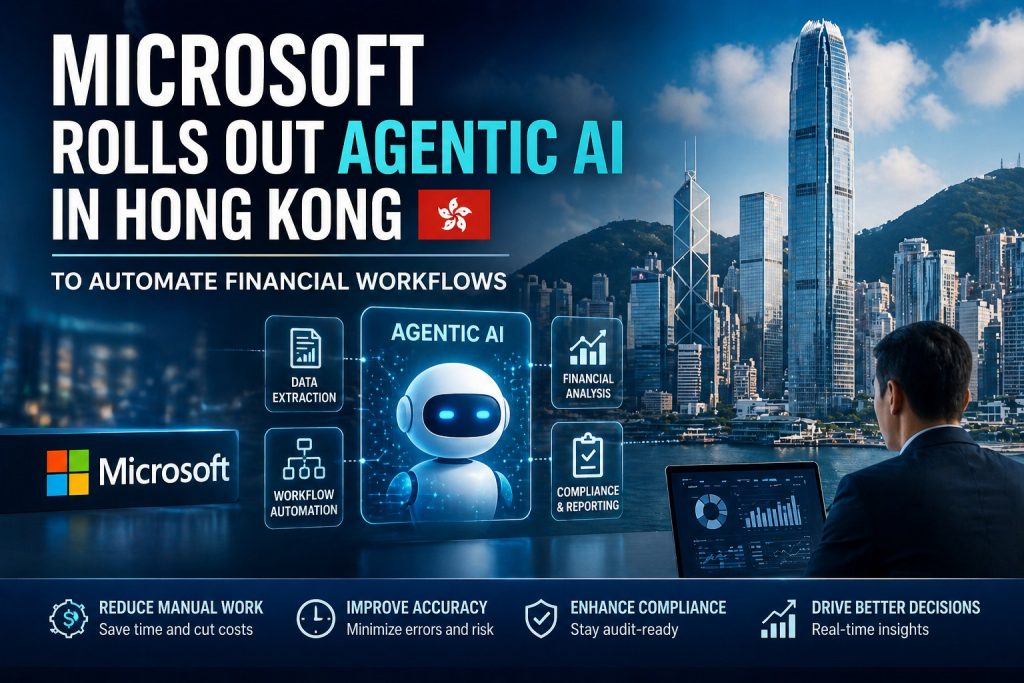
Microsoft is rolling out its enterprise AI suite in Hong Kong as organisations move from pilot projects to broader deployment of AI in core operations. The company announced the regional launch during the Microsoft AI Tour in Hong Kong, positioning the update as part of its “Frontier Success” approach to scaling agentic AI with governance and security built in. This marks a significant step in Microsoft’s long-term strategy to embed autonomous AI agents across financial services, retail, and enterprise workflows in Asia.
The tech giant will deliver the capabilities through Microsoft 365 E7 (Frontier Suite), which reaches general availability in Hong Kong on 1 May 2026. The suite combines Microsoft 365 Copilot, Work IQ, and Agent 365, alongside enterprise security, identity, and governance tools. Rather than selling point solutions, Microsoft is packaging AI governance, agent management, and productivity tools together — presenting a comprehensive enterprise offering that goes beyond what most competitors currently provide in the region.
Work IQ and Agent 365: The Core of the Platform
Work IQ grounds AI in business context by enabling it to understand how employees collaborate and how work is structured across an organisation. This contextual awareness allows AI agents to operate with greater relevance to actual business processes, rather than functioning as disconnected automation tools. Agent 365, meanwhile, centralises the management and governance of AI agents — giving IT departments visibility and control over which agents are active, what data they access, and how they operate within compliance boundaries.
For financial institutions operating in regulated environments, this combination is particularly valuable. Agent governance ensures that autonomous AI systems remain within defined parameters, while Work IQ’s contextual understanding helps agents apply the right logic to the right processes. Microsoft is essentially offering a “responsible AI at scale” package, which addresses two of the biggest concerns holding back enterprise AI adoption: security risks and lack of governance frameworks.
AIA and AS Watson Group Lead the Early Adoption
Among the early adopters, AIA — one of Asia’s largest insurers — is using Microsoft’s platform across multiple functions including claims processing, customer self-service, and lead management. The company has also developed a Copilot Studio-based programme to build internal applications tailored to its operations. These deployments aim to reduce manual processes while maintaining compliance within one of the most heavily regulated sectors in the region.
AS Watson Group, the international health and beauty retailer, is applying Microsoft’s tools across its retail operations. Use cases include product discovery, in-store personalisation, and marketing support — alongside internal productivity improvements. For a retail business with thousands of stores across Asia, the ability to personalise customer interactions at scale while maintaining internal efficiency represents a meaningful competitive advantage. AI agents handle the repetitive work, freeing staff to focus on higher-value customer engagement.
Our Take
Microsoft’s push into Hong Kong with agentic AI signals a broader shift from AI experimentation to operational deployment in Asian enterprise markets. The fact that regulated industries like insurance are leading adoption suggests that governance-first AI platforms will win out in markets where compliance is non-negotiable.
For Southeast Asia, the Hong Kong model offers a useful template. Regulated sectors — banking, insurance, healthcare — are typically the last to adopt new technology, but when they do, the implementation tends to be more durable and scalable. AIA’s use of Copilot Studio to build custom applications within a compliance-heavy environment is exactly the kind of real-world AI deployment that will either validate or challenge the agentic AI narrative.
The question is whether Microsoft’s 35-year presence in Hong Kong translates to meaningful advantage as local competitors and other global tech giants race to offer similar governance-focused AI platforms. For now, Microsoft has the first-mover edge in packaging all of this together under one umbrella — but the window may not stay open for long.
Keyword: agentic AI Hong Kong