
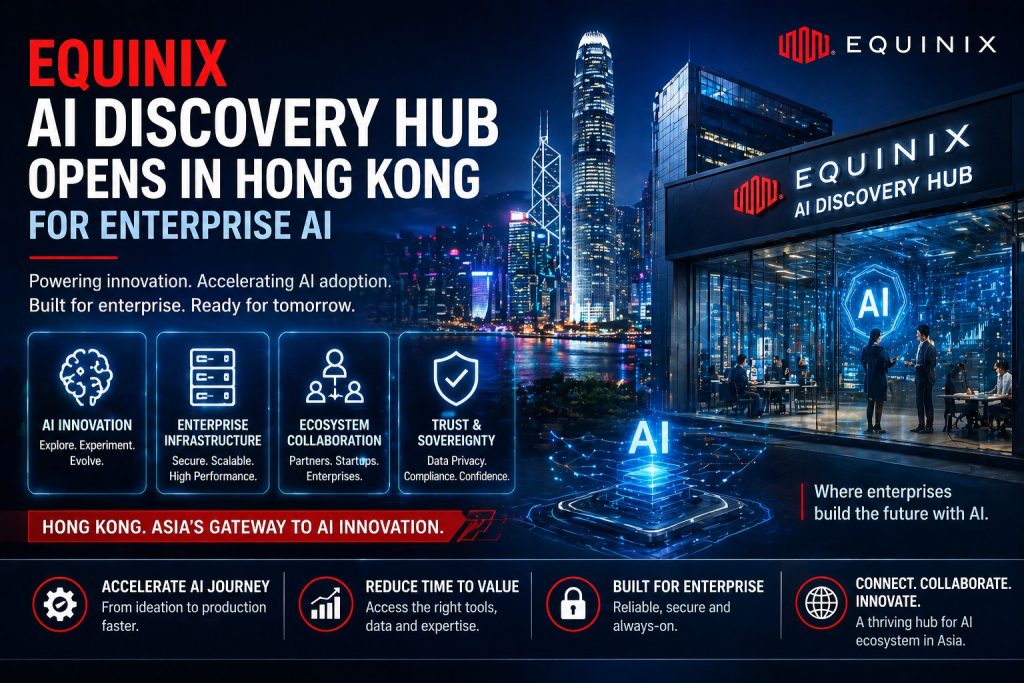
Equinix AI Discovery Hub Opens in Hong Kong for Enterprise AI

TLDR:
- Equinix partners with HPE to launch AI Discovery Hub in Hong Kong
- Facility combines HPE hardware with NVIDIA software for enterprise AI workloads
- HK6 data centre features direct-to-chip liquid cooling for high-performance GPU clusters
- Opens H2 2026, targeting banks, insurers and enterprises with regulated AI needs
A New AI Testing Ground for Enterprises
Digital infrastructure giant Equinix is partnering with Hewlett Packard Enterprise (HPE) to launch the Equinix AI Discovery Hub in Hong Kong. The facility, scheduled to open in the second half of 2026, is designed specifically for enterprises and financial institutions that need a secure environment to build, test, and deploy AI workloads under strict regulatory conditions.
The hub combines HPE’s AI factory infrastructure with NVIDIA software, including NeMoClaw, Agent Toolkit, and OpenShell. This pairing allows companies to move AI projects from experimental pilots into full-scale production without the typical bottlenecks around data silos, latency, and compliance hurdles that often slow down financial sector innovation.
Why the Financial Sector Needs This
For banks and insurers, moving sensitive customer data to public cloud environments has always presented regulatory challenges. The Equinix AI Discovery Hub addresses this by allowing financial institutions to build and test models—including real-time inference systems and autonomous AI agents—within a controlled, on-premises infrastructure that keeps data processing close to existing networks.
This approach reduces latency significantly while supporting compliance requirements that regulated institutions must adhere to. Vincent Kwok, Managing Director at HPE Hong Kong and Macau, explained that the focus is on helping organisations operationalise AI without adding complexity through a unified operating model.
HK6 Data Centre and Cooling Technology
The facility will be housed in Equinix’s HK6 data centre, which uses direct-to-chip liquid cooling technology. This is critical for handling the thermal demands of high-performance GPUs required for AI training workloads. As AI models become more complex, traditional air cooling systems struggle to maintain optimal temperatures, making liquid cooling a necessary investment for serious AI infrastructure.
HPE’s infrastructure includes built-in governance modules alongside the NVIDIA software stack. These policy-based controls and governance features are specifically designed for sensitive and regulated workloads, giving financial institutions the confidence to experiment with advanced AI applications without compromising on security or compliance standards.
Hong Kong’s AI Inflection Point
Joanne Hon, Managing Director at Equinix Hong Kong, noted that Hong Kong is at an inflection point where AI is moving from experimentation into day-to-day operations. As enterprises scale these technologies, they frequently encounter practical constraints around latency, throughput, cloud access, and governance—challenges that the AI Discovery Hub is specifically designed to overcome.
Companies will be able to use the facility to validate their AI applications under real-world conditions before committing to full-scale rollouts. This is particularly valuable for organisations that want to test performance, security, and compliance in a contained environment before making significant infrastructure investments.
Our Take
The Equinix AI Discovery Hub represents a timely solution for Asia’s financial sector, which has long struggled to balance AI innovation with regulatory compliance. By offering a purpose-built testing environment that keeps data processing in-country, Equinix is addressing a genuine pain point for banks and insurers who can’t simply dump sensitive workloads into public clouds.
For Malaysian enterprises watching this space, the implications are clear: as AI moves from experimental to operational, infrastructure matters. The success of hubs like this one will likely drive more regional investment in dedicated AI infrastructure, and companies that get early access to such facilities will have a competitive edge in deploying compliant, high-performance AI systems.
The direct-to-chip liquid cooling at HK6 is also worth noting—this signals a new standard for AI-ready data centres in the region. Expect more facilities to follow suit as GPU-intensive workloads become the norm rather than the exception.
Source: