


TSMC Chipmaking Prices Set to Rise Up to 10% in 2027: What It Means for Malaysia

TLDR
- TSMC is set to raise chipmaking prices by up to 10% in 2027, hitting both advanced and mature nodes.
- The bump reflects soaring material costs, pricier lithography gear, and the bill for TSMC’s overseas fab build-out (Arizona, Kumamoto, Dresden).
- Customers were told to expect the hike before signing 2027 wafer-start deals, sources say.
- Malaysia is on the hook indirectly — TSMC’s Penang backend packaging facility and local OSAT partners absorb a share of the reset.
- Price pressure is expected to ripple through chip designers and downstream OEMs, with thin margins likely squeezed first.
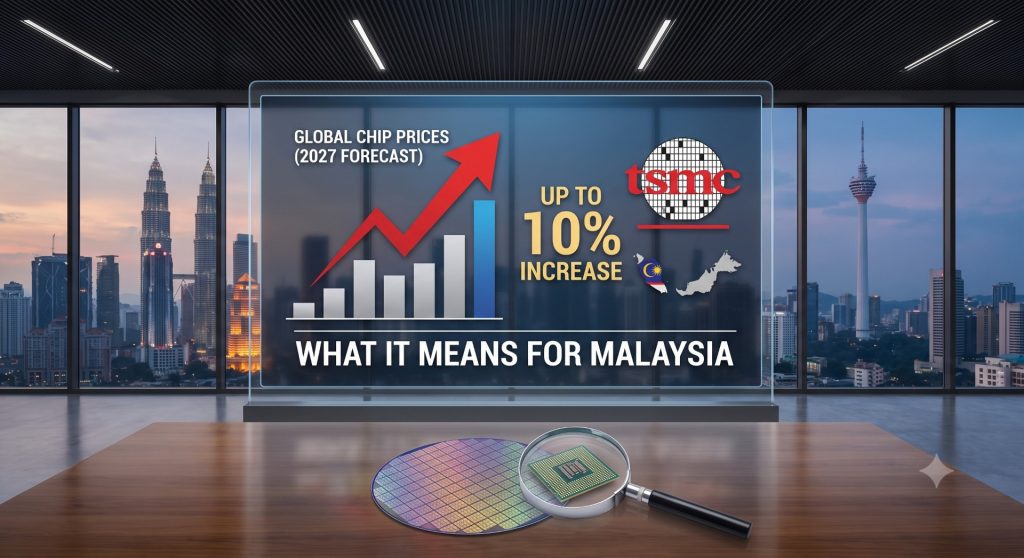
Taiwan Semiconductor Manufacturing Company (TSMC) is preparing to raise chipmaking prices by as much as 10% across both its leading-edge and mature process lines beginning in 2027, multiple sources familiar with the talks told Nikkei Asia. The world’s largest contract chipmaker has already begun flagging the increase during negotiations for next year’s wafer-start agreements.

The hike is driven by three converging pressures: rising raw material and silicon wafer costs, the eye-watering price of the latest ASML EUV lithography systems, and heavy capital outlay for overseas fabs — including TSMC’s Arizona complex in the US, its second Japan site in Kumamoto, and the new European plant in Dresden. TSMC has signalled a “less aggressive” approach than some peers, with the 10% figure sitting at the upper end rather than applying across the board.
The shift marks a notable moment in the chip industry. The “Moore’s law dividend” — steady price-per-transistor declines — kept wafer costs on a downward slope even as features shrank. A formal 10% reset across both ends of TSMC’s catalogue is a louder signal that the era of cheap silicon deflation is ending.
What The Hike Covers — Advanced And Mature Nodes
Unlike the more surgical price moves TSMC has made in the past, this round affects the full menu. Advanced nodes — the 3nm and 2nm processes underpinning AI accelerators, flagship smartphones, and high-end CPUs — will see increases tied to multi-billion-dollar EUV tooling investments. Mature nodes — the 28nm, 16nm, and 12nm workhorses powering automotive chips, microcontrollers, and industrial devices — will also rise, reflecting materials inflation and slower depreciation on legacy lines.
The practical impact depends on negotiating power. Apple, Nvidia, Qualcomm, AMD, and MediaTek — TSMC’s top-five customers — are widely expected to absorb most of the increase without passing it on, given the premium positioning of their products. Smaller fabless players in automotive and industrial markets with tighter margins are more likely to see the bump flow through to component pricing in 2027 and 2028.
Why Malaysia Should Care
The Malaysia angle is real, even if indirect. TSMC operates a major backend packaging and testing presence in Penang through TSMC AP Solar Manufacturing Malaysia, handling advanced packaging steps for chips fabricated in Taiwan. When TSMC raises wafer prices, downstream packaging partners and local OSAT players — ASE, Inari Amertron, Unisem, and the wider Penang cluster — feel knock-on effects through test allocation, package pricing, and customer mix shifts.
For Malaysian electronics manufacturers — the assembly, test, and box-build operations in Kulim, Bayan Lepas, and Senai — a 10% wafer reset means tighter cost negotiations with chip suppliers and sharper competition for the fixed pool of mature-node capacity TSMC allocates each year. MIDA has spent three years positioning Malaysia as a friend-shoring destination; a higher TSMC baseline makes that proposition more expensive but reinforces the strategic value of having Malaysian capacity as a hedge.
Our Take
This is not a “chip shortage 2.0” headline — supply is fine, demand is healthy, and TSMC is in a position of strength. What it signals is the slow but firm end of the cheap-silicon era. Geopolitical fragmentation (US, Japan, EU fab build-outs), rising EUV tooling costs, and tighter export controls have reshaped TSMC’s cost structure. A 10% increase is, in that light, almost modest.
For Malaysian readers, the practical takeaway is twofold. First, anyone sourcing chips for hardware products should expect contract renegotiations in the second half of 2026 to be more adversarial than usual — get ahead of them. Second, Malaysia’s semiconductor ambitions — the Penang cluster, the Kulim hi-tech park, the new data centre and AI server assembly investments — become more strategically valuable as customers look for capacity outside Taiwan’s higher-priced core. The country benefits from being a credible alternative, even without headline-grabbing leading-edge fabs.
In short, TSMC’s 10% hike is a real number with real consequences, and a confirmation that the chip industry’s centre of gravity is shifting — and Malaysia has a stake in where it lands.





[…] 📖 Baca versi English: TSMC Chipmaking Prices Set to Rise Up to 10% in 2027: What It Means for Malaysia […]