
TNB Green Electricity Tariff (GET): Smart Financial Hedge Or Expensive Lock-In For Malaysian Households

TLDR
- TNB’s Green Electricity Tariff (GET) charges a fixed premium on top of the base rate (5/4/3 sen/kWh for 1/2/3-year contracts) in exchange for exemption from the AFA surcharge and the 1.6% KWTBB tax
- The premium is only billed against your subscribed block or your actual consumption — whichever is lower
- The break-even depends on where the monthly AFA lands: at recent peaks around +3.70 sen/kWh, a 3-year GET saves money; at a hypothetical +2.50 sen, a 2-year GET can lose
- Upgrading to high-efficiency hardware can quietly destroy the GET margin by lowering total consumption
- 1-year contracts at 5 sen/kWh are bad math in almost every scenario; the 3-year tier gives the strongest safety margin
What GET Actually Is (And What It Isn’t)
The TNB Green Electricity Tariff is usually framed as a sustainability play. For most subscribers — especially households and small commercial operators running homelabs, rendering rigs, or heavy air conditioning — it’s better understood as a financial hedging tool.

Subscribing to GET does not buy you renewable energy credits or change the source of the electricity flowing through your meter. What it does is remove two specific line items from your bill for the electricity units you actually consume within your subscription:
- The KWTBB tax: a flat 1.6% renewable energy fund fee applied to your base tariff.
- The AFA surcharge: the Automatic Fuel Adjustment, which replaced the older ICPT mechanism in July 2025 and updates monthly based on global coal, natural gas prices and currency exchange rates.
The golden rule is simple: a GET subscription only saves money when the combined cost of those two avoided fees is higher than the GET premium itself.
Subscription Tiers And The Block Rule
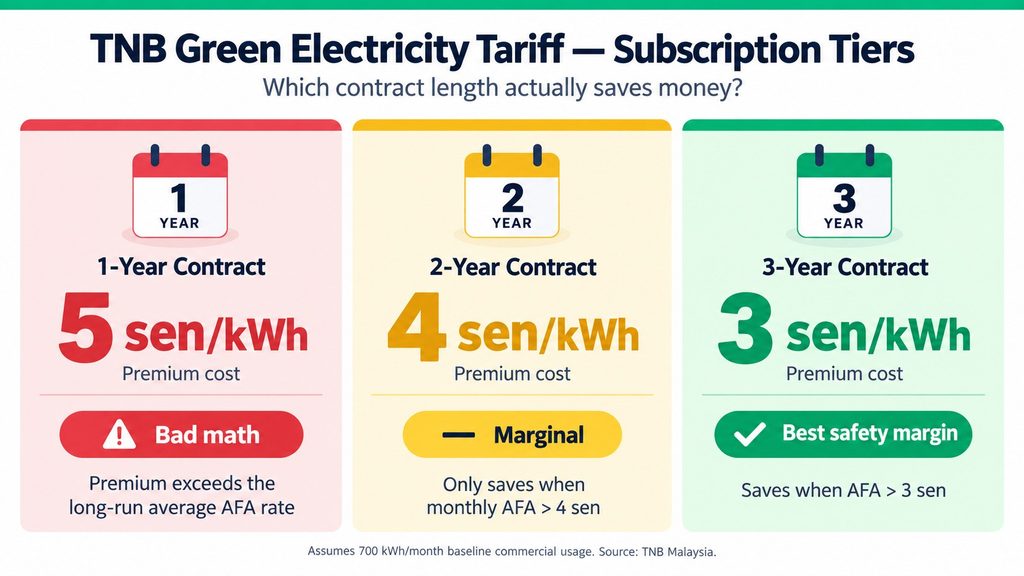
The GET premium scales down the longer you commit, but the contract also locks you in. Early termination triggers a penalty on the remaining balance. The 2026 published premium rates are:
| Contract | Premium | Math verdict |
|---|---|---|
| 1-year | 5 sen/kWh | Bad math in almost every scenario — premium exceeds the long-run average AFA rate |
| 2-year | 4 sen/kWh | Saves money only when monthly AFA exceeds 4 sen/kWh |
| 3-year | 3 sen/kWh | Saves money when AFA exceeds 3 sen/kWh — the largest safety margin |
Subscriptions are not unit-precise — TNB requires you to subscribe in blocks. Domestic (residential) accounts subscribe in 100 kWh blocks; non-domestic (commercial) accounts subscribe in 1,000 kWh blocks.
There is one crucial billing detail: the GET premium is charged only on your subscribed blocks or your actual monthly consumption — whichever is lower. A commercial property that subscribes to a 1,000 kWh block but only consumes 699 kWh in a given month pays the premium on 699 units, not 1,000. That cap is the most underappreciated safety net in the program.
The Break-Even Math: Two Scenarios
Whether GET saves you money depends almost entirely on where the monthly AFA lands. The AFA has been volatile — during peak months in mid-2026 it pushed past +3.80 sen/kWh, but it can also swing negative, which means TNB effectively rebates part of your bill.
The arithmetic below assumes baseline commercial consumption of 700 kWh per month, which is where the block cap and the AFA math become interesting. The premium column shows what GET would actually charge in each tier; the net column shows the savings or loss versus the avoided fees.
| Metric | Scenario A: High AFA (+3.70 sen) | Scenario B: Stabilised AFA (+2.50 sen) |
|---|---|---|
| Avoided fees (AFA + 1.6% KWTBB) | ~ RM 30.00 | ~ RM 21.00 |
| 3-year GET premium (3 sen) | RM 21.00 | RM 21.00 |
| 2-year GET premium (4 sen) | RM 28.00 | RM 28.00 |
| 3-year tier net | + RM 9.00 savings | Break even |
| 2-year tier net | + RM 2.00 savings | − RM 7.00 loss |
The risk is asymmetric: the 3-year tier gives you the lowest premium (3 sen) and therefore the largest safety margin against a falling AFA. The 1-year tier at 5 sen is the worst math in almost any scenario — you are paying a premium that exceeds the historical average AFA rate.
The Hardware Trap: When Efficiency Backfires
The most common mistake consumers make is subscribing to GET right before a hardware upgrade. The subscription model assumes your consumption profile stays roughly constant; the moment it drops, the absolute ringgit value of the AFA you avoid shrinks, but your fixed GET premium does not.
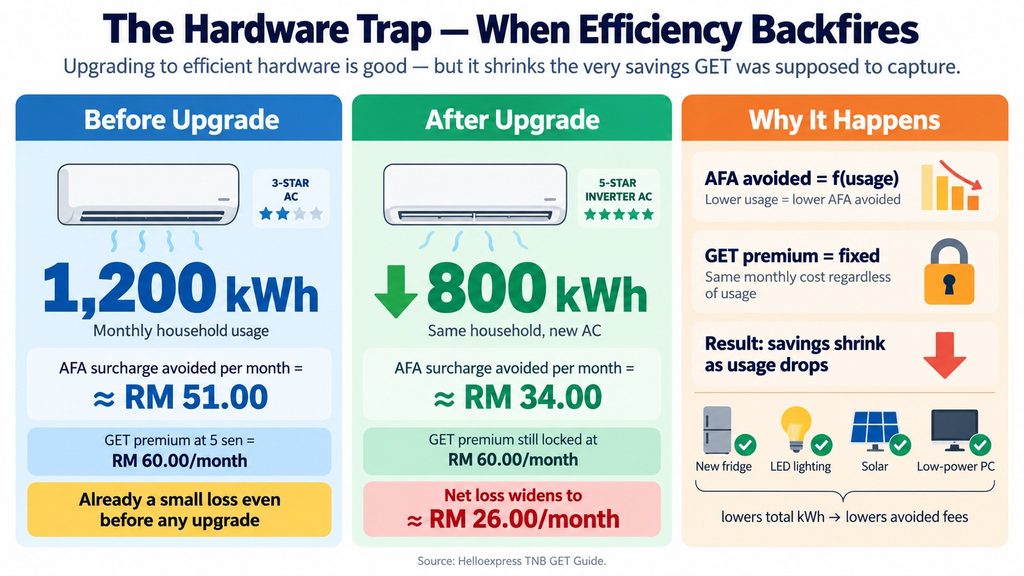
The arithmetic is unforgiving. A household that replaces a legacy 3-star non-inverter air conditioner with a modern 5-star inverter unit can cut total power consumption for that appliance by up to 68%. If that single upgrade reduces your monthly usage from 1,200 kWh to 800 kWh, the absolute value of the avoided AFA drops proportionally, but the premium you signed up for is locked in at the higher consumption level.
The pattern repeats across every efficiency play — new inverter fridges, more efficient lighting, solar-assisted setups, even a switch to lower-power workstations. Each one eats into the same fixed savings you signed up to capture. High usage equals higher surcharges, which equals a better GET margin. Low usage equals lower surcharges, which equals a negative GET margin.
Should You Subscribe?
The cleanest way to think about GET is as a price-stability hedge, not a savings strategy. With that framing, the answer becomes more straightforward.
| If you are… | Subscribe? | Why |
|---|---|---|
| A heavy-load commercial operator | Yes | Stable consumption; AFA surcharges hit you hard and consistently |
| Running crypto mining or 24/7 server racks | Yes | Constant draw means the avoided fees scale with usage |
| Want a predictable monthly operating expense | Yes (3-year tier) | Stability matters more than marginal rebates when fuel prices fall |
| A typical household with low-to-moderate use | No | Premium exceeds the typical AFA savings in most months |
| Planning efficiency upgrades in the next 12 months | No | Lower usage means lower avoided fees — the lock-in penalty compounds |
| Considering a 1-year contract | No | The 5 sen/kWh premium is mathematically hostile to most usage profiles |
| Likely to move or close the account soon | No | The early-termination penalty wipes out any accumulated savings |
Our Take
GET works as advertised when the AFA is high, and it quietly bleeds money when the AFA falls. The product is honestly priced for high-consumption users with stable loads, but the lock-in penalty and the inefficiency-of-efficiency trap mean it is the wrong answer for most households thinking about it casually. If you are a heavy-load operator with a 3-year horizon, the math can work in your favour. If you are a typical household planning any kind of efficiency upgrade, the 1.6% KWTBB plus the current AFA spread is genuinely cheaper than the lowest available GET premium, and a GET subscription will almost certainly become a regret within 18 months.
Versi Bahasa Malaysia: TNB Tarif Elektrik Hijau (GET): Lindung Nilai Kewangan Pintar Atau Kunci Mahal Untuk Isi Rumah Malaysia?