
SEA Fintech Funding Holds Steady at $682M in H1 2026 as Seed Bets Surge

TLDR
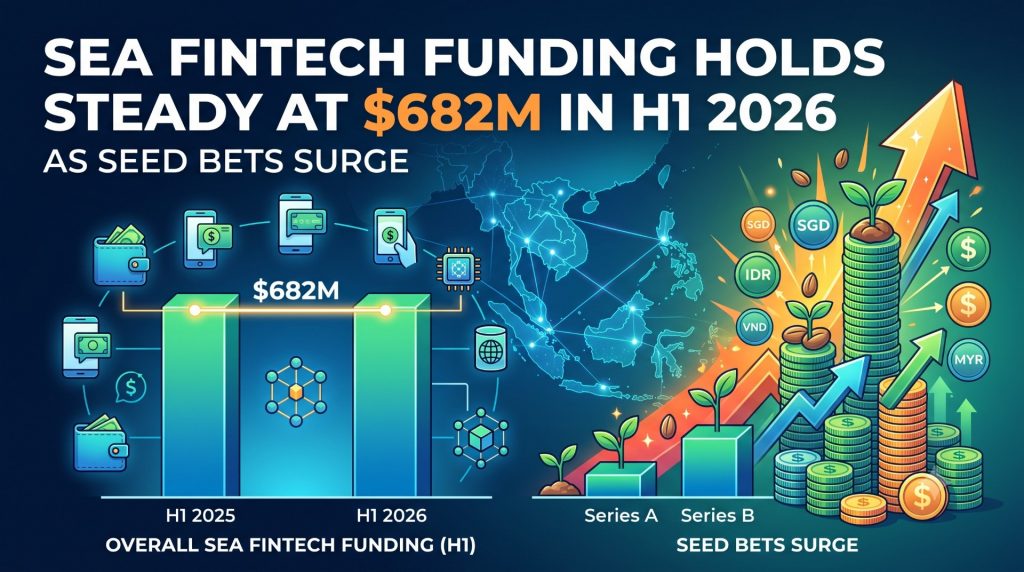
- SEA fintech raised US$682 million across the first half of 2026, per Tracxn data
- Funding slipped 4% versus H2 2025 and 3% year-on-year — a flat-but-not-collapsing picture
- Seed-stage deals surged 32% half-on-half to US$78.1m, while early-stage fell 28% to US$153m
- Airwallex’s US$320m Series H and Edena Capital’s US$100m Series D made up 62% of all capital
- Singapore kept its grip on 79% of regional fintech funding, with Taguig trailing at 9%
Southeast Asia’s fintech sector closed the first half of 2026 with US$682 million in funding, according to the latest Tracxn Technologies report. That is a 4% dip from the second half of 2025 and a 3% drop compared with the same window a year ago. On the surface, the chart looks flat — but underneath, capital is moving in very different directions depending on which rung of the startup ladder you look at.

Two mega-rounds are doing a lot of the heavy lifting. Airwallex’s US$320 million Series H and Edena Capital’s US$100 million Series D together accounted for 62% of the region’s fintech capital in the half. Strip them out and the underlying figure is closer to US$260 million, which paints a far more cautious picture for everyone else raising at smaller cheque sizes.
Seed Stage Surges, Early Stage Pulls Back
The most interesting shift is happening at the earliest end of the funnel. Seed-stage funding rose 32% from the previous half to US$78.1 million, with deal volume clearly outpacing the dollar growth. Investors are writing more, smaller checks to bet on the next generation of payment, lending, and embedded finance plays coming out of the region.
Early-stage funding, by contrast, fell 28% half-on-half to US$153 million. That is the classic barbell pattern: limited partners are happier placing seeds and following late-stage winners than they are underwriting Series A and B risk in a still-soft exit environment. For Malaysian founders, it means a tougher middle: the gap between a US$500k pre-seed and a US$10m Series A has rarely felt wider.
Singapore Still Owns 79% of the Pie
Geographically, nothing has really changed. Singapore continues to dominate Southeast Asian fintech funding, capturing 79% of the total raised. Taguig (the Philippines’ fintech hub anchored by the Bonifacio Global City district) came in second at 9%. Malaysia, Indonesia, Thailand, and Vietnam collectively split what’s left — a familiar story for any regional founder who has tried to raise capital outside the Lion City.
M&A activity cooled too. Fintech acquisitions in the region dropped 25% from the previous half, with only six deals closing. The biggest was HCL Technologies’ US$14.7 million acquisition of Finergic — a relatively small number that reflects how selective strategic buyers have become. For Malaysian fintech players hoping to be acquired rather than IPO, the message is clear: buyers are not in a rush.
Our Take
Headline numbers can lie, and the US$682m figure is doing some heavy misdirection in this report. The real story is bifurcation: a few mega-rounds masked a softer middle market, while seed capital quietly found its way back in. For Malaysian fintechs, that split matters more than the aggregate.
If you are building something pre-Series A — payments, shariah-compliant digital banking rails, an embedded finance play for SMEs, or a MY-focused crypto on-ramp — there is real money available, but you will likely raise smaller amounts at thinner valuations than your 2021 comparables. If you are raising a US$5 to US$20m round, expect longer cycles and a lot more diligence questions about path to profitability.
The Singapore concentration remains the elephant in the room. Until Malaysia’s regulators and growth-stage investors create a more competitive local capital stack — and until a Malaysian fintech proves it can scale to a credible exit — the regional pipeline will keep flowing through the same narrow channel. The good news is that the seed surge suggests investors still believe the next regional champion will come from somewhere other than Singapore. The bad news is that “somewhere” has not yet been named.