

Global Semiconductor Sales Surge 35.1% in Q2 2026, Says SIA

TLDR
- Q2 2026 chip sales reached $403.3 billion, up 35.1% over Q1 2026
- June sales alone hit $134.5 billion — a 123.6% year-on-year jump
- Asia Pacific (excluding China) led regional growth at +124.4% YoY
- 2026 industry revenue is set to exceed $1.5 trillion, SIA says
- AI, hyperscaler data centres, and advanced packaging are the main growth drivers
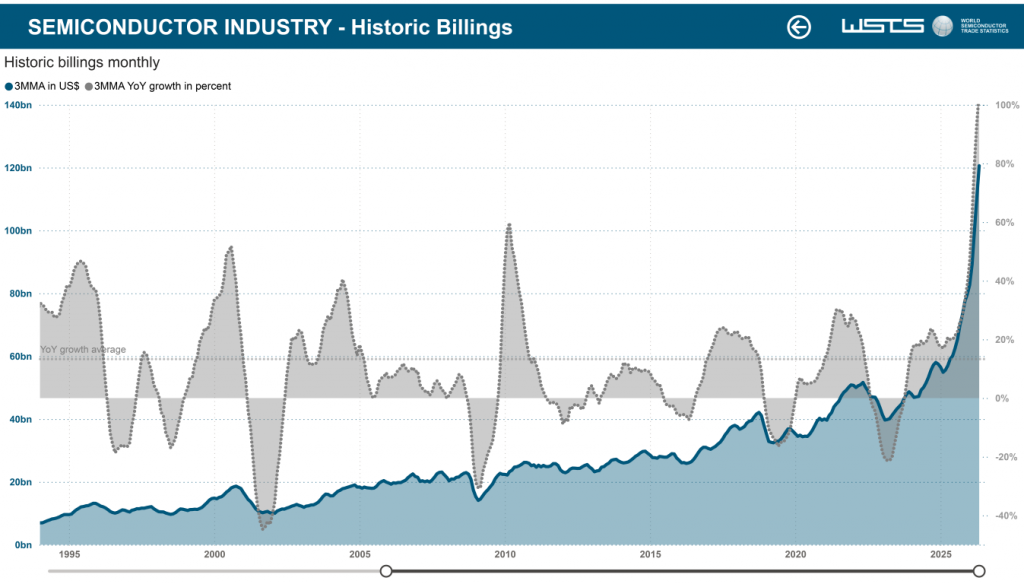
Global semiconductor sales surged to $403.3 billion in the second quarter of 2026, a 35.1% jump over Q1 2026, according to new data released by the Semiconductor Industry Association (SIA) on August 6. The industry body, which represents 99% of the US chip industry by revenue and nearly two-thirds of non-US chip firms, said the June monthly print alone came in at $134.5 billion — up 123.6% year-on-year and 9.7% higher than May.

“Global chip sales are expected to exceed $1.5 trillion in 2026, with Q2 sales substantially outpacing sales in Q1 2026,” said John Neuffer, SIA president and CEO. Neuffer credited strong demand across the Americas, Asia Pacific and China as the main engine behind the record run. The monthly numbers are compiled by the World Semiconductor Trade Statistics (WSTS) organisation using a three-month moving average.
Asia Pacific Powers The Boom
Regionally, every major market grew in June compared with a year earlier. The Americas led with 160.9% year-on-year growth, followed closely by Asia Pacific/All Other at 124.4% and China at 112.8%. Europe climbed 75.2%, while Japan posted a more modest 39%. Month-on-month, China rose 10.4%, Asia Pacific/All Other 9.8%, the Americas 9.6%, Japan 8.6%, and Europe 7.7%.
For Malaysia, that 124.4% Asia Pacific figure is more than a headline — it reflects the boom playing out across Penang, Kulim and the wider northern corridor. Major outsourced semiconductor assembly and test (OSAT) players such as Inari Amertron, Unisem and Globetronics have all reported capacity expansion this year, while Penang’s back-end packaging and test cluster continues to absorb fresh investment. The Straits Times reported earlier this week that AI and chips are turning Malaysia into Asia’s growth standout, and these SIA numbers reinforce that narrative.
What Is Driving Demand
Behind the surge is the same story that has dominated the industry for the past 18 months: generative AI training and inference workloads at hyperscalers like Microsoft, Google, Amazon and Meta, all of which are ordering up high-bandwidth memory, custom accelerators and advanced-packaging capacity. The build-out of AI-ready data centres in the US, Europe and Southeast Asia is pulling through demand for logic chips, high-end DRAM, NAND, and the increasingly strategic advanced packaging lines where Malaysia plays a key role.
Equipment makers and wafer foundries are reporting near-full order books. Specialty gas suppliers have flagged tightening supply of high-purity gases used in etching and deposition, a sign that fab utilisation is running close to peak. Analysts say the bottleneck is shifting from wafer supply to back-end packaging and HBM stacking capacity — exactly the segment where Malaysian OSATs are scaling fastest.
2026 On Track For A Trillion-Dollar Year
SIA is now projecting full-year 2026 sales above $1.5 trillion — a milestone that would have seemed unthinkable three years ago. The 35.1% sequential jump is unusually sharp and partly reflects the lumpy nature of memory pricing, but even adjusted for that, underlying logic and analogue growth remains well into double digits.
The bigger question for 2027 is sustainability. If hyperscaler capex normalises, as some analysts expect, sequential growth will inevitably slow. For now, the data confirms that the chip cycle still has legs — and that Malaysia’s position as a critical back-end hub is paying off in real revenue terms.
Our Take
The headline 35.1% jump is impressive, but the more interesting number for Malaysia is the 124.4% Asia Pacific growth. It validates the long-running bet that the country could move up the semiconductor value chain from back-end packaging into higher-value work like advanced packaging, photonics test and AI-chip characterisation. For Malaysian engineers and STEM graduates, the message is clear: the demand is real, and the cluster is hiring.
The risk is the same one SEMICON SEA flagged earlier this year — a chronic shortage of experienced process and yield engineers means Malaysia will need to scale TVET and university programmes faster than the fabs themselves are expanding. The boom is here; the talent pipeline is the bottleneck. For policymakers, the priority should be fast-tracking MIDA-approved training pipelines and keeping the foreign-knowledge-worker pathway open while local cohorts scale up.