

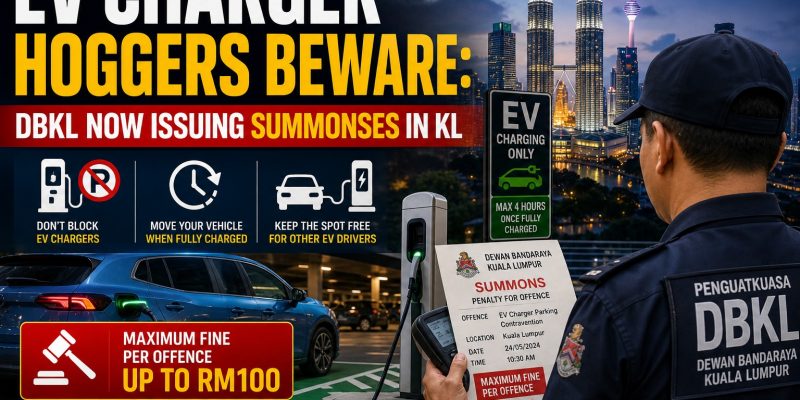
EV charger hoggers beware: DBKL now issuing summonses in KL

TLDR:

- Kuala Lumpur City Hall (DBKL) has started issuing summonses for vehicles hogging designated EV charging bays in the city
- The compound penalty starts at RM30 if settled within 7 days, rising to RM50 (8-15 days), RM80 (16-30 days), and RM100 after 30 days
- Offenders are being charged under Perintah Pengangkutan Jalan (Peruntukan Tempat Letak Kereta) (WPKL) 2016, specifically Perintah 15(1)
- The enforcement action targets both EV and internal combustion engine vehicles that occupy charging bays without charging
- JomCharge has clarified that customers using their street-level EV chargers are not required to pay parking fees
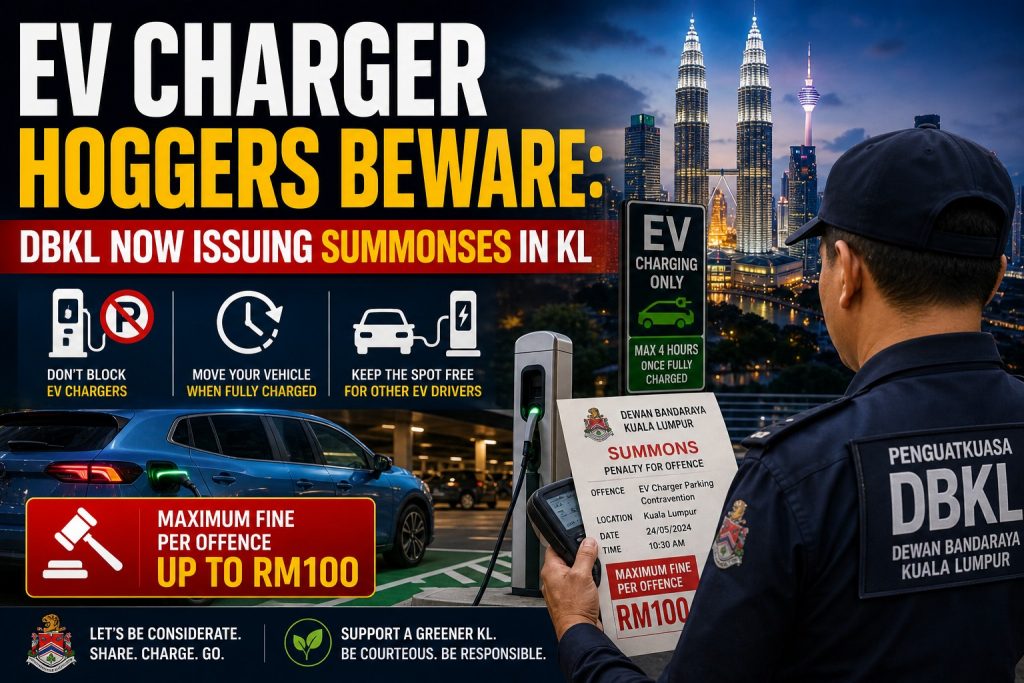
Kuala Lumpur City Hall (DBKL) has begun enforcement action against vehicles found occupying designated EV charging bays across the city. The move follows repeated complaints about charging spots being blocked by vehicles — both electric and petrol-powered — preventing actual EV users from accessing the infrastructure they need.
The street-level EV chargers deployed in partnership with charge point operators such as JomCharge were specifically designed to expand charging access and support the growing adoption of EVs in Malaysia. However, a persistent lack of civic mindfulness has caused significant inconvenience for EV drivers who depend on these public charging points. The enforcement action signals that authorities are finally taking the issue seriously.
A Legally Recognised Offence
The violation is being prosecuted under Perintah Pengangkutan Jalan (Peruntukan Tempat Letak Kereta) (WPKL) 2016, specifically Perintah 15(1), which prohibits parking in reserved spaces without proper use. In this case, the offence is clearly stated as placing a vehicle in a petak khas kenderaan EV — a designated EV charging bay.
This is not a grey area. EV charging bays are legally recognised as “petak khas” (special-use parking), which means parking in one without the intent to charge is a genuine violation — not just a social faux pas. The recent sighting of a petrol-powered vehicle hogging a JomCharge EV bay at McDonald’s Sri Petaling, which resulted in a compound notice being issued, confirms that enforcement is active and operational.
Compound Rates: RM30 to RM100 Depending on Timing
The compound structure is tiered to incentivise quick payment while allowing flexibility for those who need more time:
- RM30 if settled within 7 days
- RM50 if settled between 8th and 15th day
- RM80 if settled between 16th and 30th day
- RM100 after 30 days, with the possibility of court action if left unpaid
The escalating penalty structure is designed to discourage delay and ensure bay spaces are freed up promptly. For most drivers, settling within the first week at RM30 represents the least costly outcome — both financially and in terms of avoiding further legal complications.
A Reminder for All Drivers
With enforcement now in place, this should serve as a clear reminder that EV charging bays are not regular parking spots. The rule applies regardless of what vehicle you drive — if you are not actively charging, you have no business occupying the bay.
Charging bays exist specifically for vehicles that need to charge, and once you are done, you should free up the space as soon as possible to allow others to use it. JomCharge has also clarified that customers using their street-level EV chargers are not required to pay parking fees, which means there is no financial justification for staying parked after charging is complete.
Why This Matters for Malaysia’s EV Ambitions
Malaysia has been pushing to increase EV adoption as part of its broader green mobility goals. A critical part of making EV ownership viable — especially for those without home charging capabilities — is ensuring public charging infrastructure is accessible and reliable. When charging bays are blocked by non-EV vehicles or EVs that have finished charging and are simply parked, it undermines the entire proposition.
Proper enforcement of charging bay usage is therefore not just about traffic compliance — it is about building confidence in EV ownership. Drivers who know they can rely on finding an available public charger are more likely to consider switching to an electric vehicle. This, in turn, supports Malaysia’s stated goals around electric vehicle adoption and reduced carbon emissions from the transport sector.
As more EV chargers are deployed across the city, proper usage becomes critical to ensure fair access for everyone. The message from DBKL is clear: if you are not charging, you are hogging — and that now carries a financial consequence.
Our Take
DBKL’s decision to start issuing summonses for EV charger hogging is a welcome and overdue step. For years, EV owners in Kuala Lumpur have had to deal with the frustration of finding charging bays occupied by vehicles that have no business being there. The combination of public education campaigns and genuine enforcement is the right approach.
The tiered compound structure strikes a reasonable balance — it is not punitive enough to be seen as overly harsh, but it carries enough financial weight to deter repeat offences. The RM30 initial fine is modest enough to avoid controversy while still being meaningful.
What will be worth watching is whether enforcement remains consistent and whether similar action is replicated in other local authorities beyond KL. If DBKL’s approach proves effective, it could serve as a template for other cities in Malaysia grappling with the same issue. The broader message is clear: as EV infrastructure expands, the norms around how we use it need to be embedded into everyday driving behaviour. This is how a city builds a culture that supports clean transport.
Source:
– SoyaCincau – EV charger hoggers beware: DBKL now issuing summonses in KL