
OPPO Find X10 Pro Max Confirmed With MediaTek Dimensity 9600 Pro On TSMC 2nm, Plus OPPO Laminar Flow Engine

TLDR
- OPPO Find X10 Pro Max will be among the first phones to run MediaTek’s flagship Dimensity 9600 Pro on TSMC’s 2nm N2P process
- CPU bumps to two 4.55GHz C2-Ultra cores plus six performance cores, 17% faster than the previous generation
- New G2-Ultra NX GPU delivers 27% higher sustained performance with enhanced ray tracing
- Dual-NPU AI design: 51% faster LLM prefill, 40% more power efficient for always-on tasks
- OPPO Laminar Flow Engine debuts alongside the chip, jointly developed with MediaTek
- Global launch event details still under wraps; Find X10 Pro Max will roll out to international markets afterwards
OPPO Find X10 Pro Max Confirmed For MediaTek Dimensity 9600 Pro
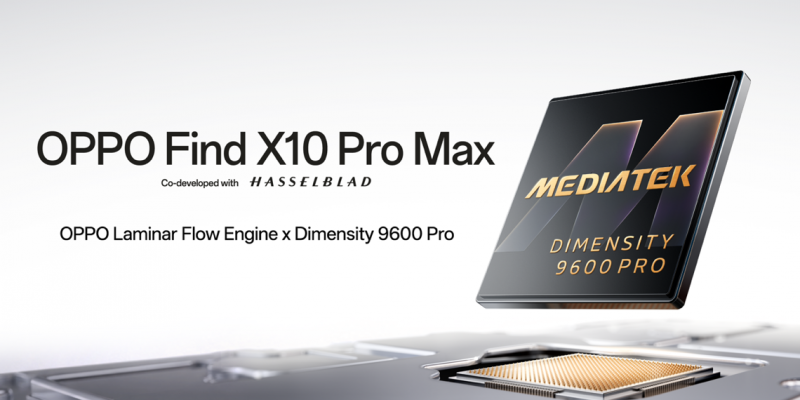
OPPO has confirmed that its upcoming Find X10 Pro Max will be among the first smartphones to ship with MediaTek’s new flagship Dimensity 9600 Pro chipset, built on TSMC’s 2nm N2P process. The announcement, out of Shenzhen on 15 September 2026, locks in the performance story for what will be OPPO’s most powerful international-market flagship to date.
CPU And GPU: 17% Faster, 27% Higher Sustained Performance
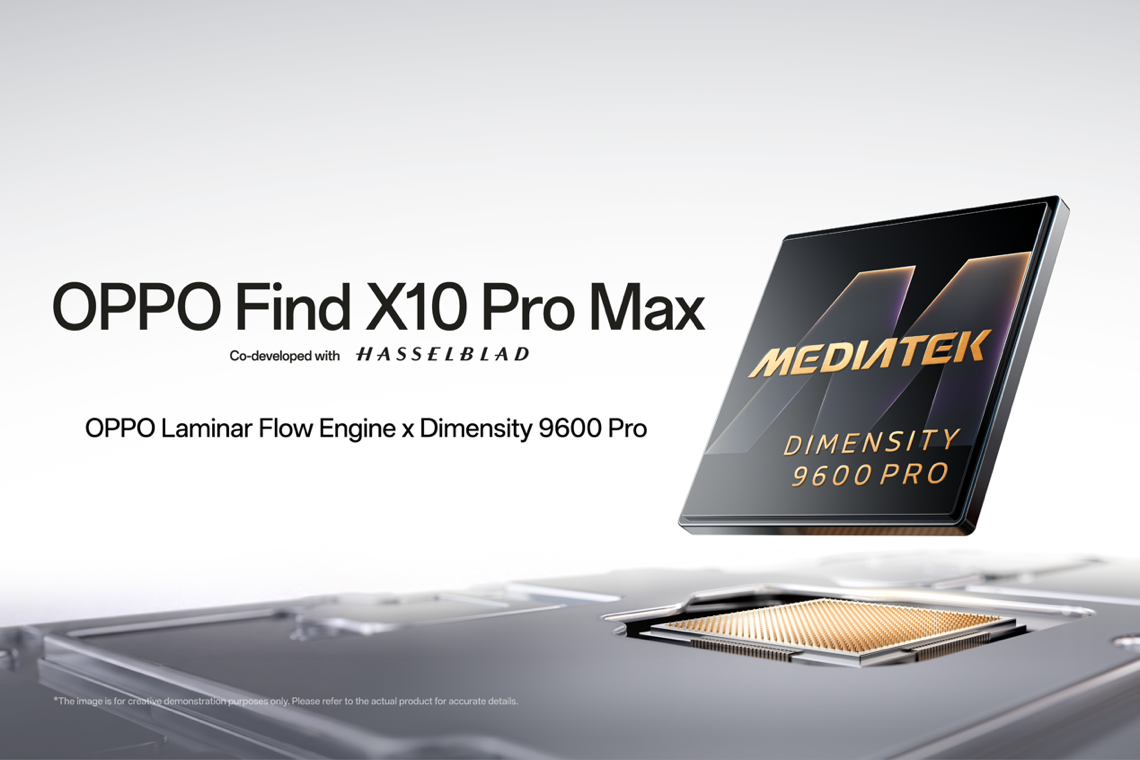
MediaTek is sticking with its All-Big-Core architecture but stepping up the configuration: two 4.55GHz C2-Ultra cores paired with six performance cores, each with independent frequency control for finer workload scheduling. The result is a 17% overall CPU performance improvement over the previous generation, with the energy-efficiency curve widening to 61% in multi-core workloads. On the GPU side, the new G2-Ultra NX adds enhanced ray tracing plus new neural graphics capabilities, delivering around 27% higher sustained performance under heavy gaming loads — enough to matter for extended sessions rather than just benchmark numbers.
AI: Dual-NPU Design With 51% Faster LLM Prefill
The Dimensity 9600 Pro’s headline AI pitch is the new dual-NPU design: a high-performance NPU that delivers 51% faster LLM prefill, and a Super-Efficient NPU that is 40% more power-efficient for always-on tasks. The split mirrors what other flagship platforms have started doing — keep heavy inference fast on one NPU, push persistent background tasks to a low-power core — but the 51% prefill improvement is genuinely useful for on-device generative features, where the time-to-first-token is the metric most users actually feel.
OPPO Laminar Flow Engine: Joint Work With MediaTek
The chip is only half the story for the Find X10 Pro Max. OPPO is also debuting its Laminar Flow Engine on the phone, a rendering architecture the brand co-developed with MediaTek. The pitch is closer coordination between the system scheduler and the rendering pipeline, with the goal of faster app launches and smoother content loading under heavy demand — including rapid photo browsing, which is the test case OPPO called out. This is the kind of feature that lives or dies on whether OPPO has the platform control to actually integrate it well, and the joint-development framing suggests both teams are aligned on the priority.
What It Means For The Find X10 Pro Max
International-market OPPO flagships have spent the last two generations leaning on Snapdragon silicon, so a MediaTek-led Find X10 Pro Max is a notable shift — not because of the brand, but because the 2nm N2P process is the same node most flagship chips will land on through 2027. The performance claims (17% CPU, 27% GPU, 51% AI prefill) are the kind of generational jumps that put the Find X10 Pro Max within striking distance of the Snapdragon 8 Elite Gen 2 and Apple A20 Pro in raw output. Whether that translates to better real-world battery life and thermals is what the reviews will need to confirm. Full Find X10 Pro Max details will land at the global launch event later this month.
Our Take
OPPO’s flagship-tier bet on MediaTek is the more interesting story here than the spec sheet. A 2nm Dimensity 9600 Pro inside a Find X10 Pro Max gives OPPO parity on process node with the rest of the flagship class, and the dual-NPU split plus Laminar Flow Engine point to a generation where on-device AI and system responsiveness are doing more of the heavy lifting than peak benchmark scores. The risk for buyers is software polish — OPPO’s ColorOS has matured a lot in two years, but the usual first-generation-on-new-chip teething issues will be worth watching for once the launch happens.