

Intel’s EMIB-T Packaging Hits 50% Cost Advantage Over TSMC CoWoS, Volume Production Set for 2027

TLDR
- Intel’s EMIB-T advanced packaging reportedly costs 50% less than TSMC’s CoWoS technology
- Package yields are approaching 90%, with substrate yield the last hurdle to clear
- Volume production slated for 2027, with Intel paying overtime bonuses at Ohio fab to stay on track
- TSMC is already building its own EMIB-like alternative as CoWoS demand stays choked through 2026
- Malaysia’s AT&S Kulim facility sits inside the substrate supply chain for the new packaging tech
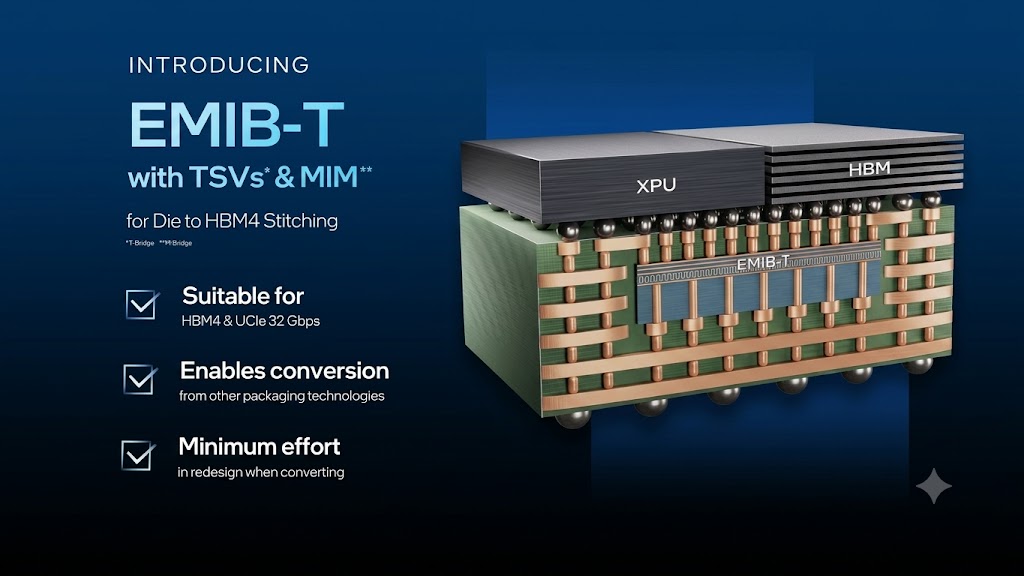
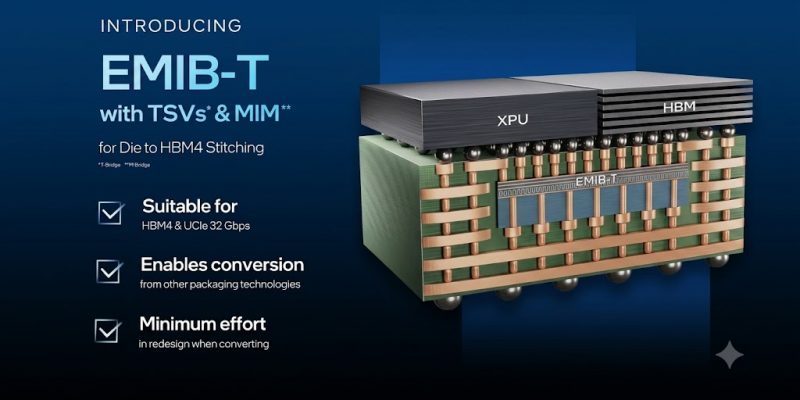
Intel is closing in on a significant breakthrough in advanced chip packaging that could finally give the company a credible answer to TSMC’s CoWoS dominance. The company’s EMIB-T technology, an evolution of its Embedded Multi-die Interconnect Bridge architecture, is reportedly around 50 percent cheaper to produce than TSMC’s CoWoS, the workhorse packaging solution behind nearly every high-end AI accelerator shipping today.
The cost gap stems from a structural redesign. EMIB-T eliminates the expensive silicon interposer that sits at the heart of CoWoS, replacing it with tiny silicon bridges embedded directly into the organic substrate. The T variant adds Through-Silicon Vias that route power vertically through the bridges, enabling 3D stacking at a fraction of the cost. The timing matters. CoWoS capacity at TSMC has been choked since the AI accelerator boom kicked off, with Nvidia, AMD, and a long queue of hyperscaler customers fighting for allocation.
Yield Ramp And The Ohio Fab Push
Intel now expects package yields on EMIB-T to approach the 90 percent mark, a level that would make the technology commercially viable for external foundry customers. The remaining bottleneck is substrate yield, which is currently hovering around 50 percent. Intel’s substrate supply chain includes Ibiden as the primary anchor, alongside Shinko, Unimicron, and Austria’s AT&S, the last of which operates a major facility in Kulim, Kedah that has been ramping advanced substrate output through 2026.
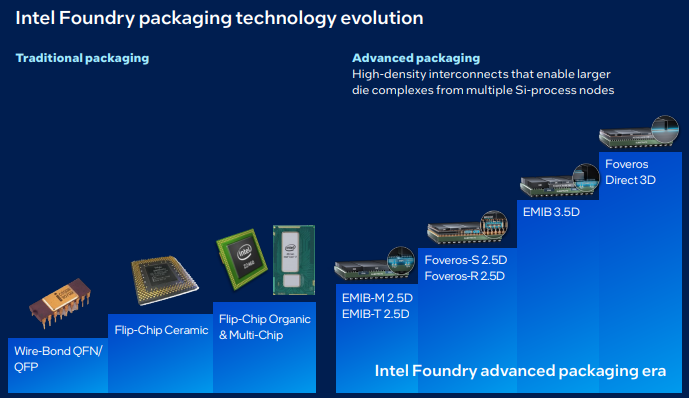
To keep the broader timeline on track, Intel has begun paying generous overtime bonuses at its Ohio fab complex, a 1,000-acre site that will anchor production of the 18A and 14A Angstrom-era nodes. The push aims at high-volume 14A production by 2031, a timeline reaffirmed earlier this year after Intel landed Apple as a customer. EMIB-T will be one of the key differentiators Intel offers alongside those leading-edge nodes, particularly for cost-sensitive AI customers who do not need the absolute top tier of Nvidia-class performance.
TSMC’s Counter-Move
TSMC is not standing still. The Taiwanese foundry has reportedly begun developing its own EMIB-like advanced packaging solution to sit alongside its bulkier CoWoS-L offering. The move is a tacit acknowledgement that Intel’s bridge-based architecture is a credible contender, particularly for customers priced out of the CoWoS queue. CoWoS demand is expected to remain choked through at least 2026, which keeps the door wide open for alternatives to grab market share.
The substrate supply chain reflects how globalised this fight has become. Japanese substrate maker Ibiden anchors Intel’s supply, while Unimicron in Taiwan and AT&S in Austria and Malaysia feed both Intel and TSMC’s packaging lines. Malaysia’s role is increasingly central, with Kulim and Penang hosting the advanced packaging substrate capacity that both foundries depend on.
Our Take
The 50 percent cost advantage is the kind of number that moves entire procurement strategies. For years the foundry conversation has been framed as a node leadership race, but packaging has quietly become the real bottleneck for AI silicon. CoWoS capacity has been the gating factor behind AI accelerator supply since 2024, and any technology that breaks that logjam at half the cost is going to get serious customer attention, especially from ASIC builders and second-tier accelerator vendors who cannot afford to wait in Nvidia’s queue.
For Malaysia, the strategic picture is interesting. The country’s substrate and back-end packaging cluster, anchored by AT&S in Kulim and a deep bench of OSAT players in Penang, sits squarely in the middle of this fight. Both Intel and TSMC rely on Malaysian-made advanced substrates, which means Malaysia captures value regardless of which foundry wins the packaging race. The bigger long-term question is whether Malaysia can climb further up the stack from substrates into actual advanced packaging services, the way it climbed from assembly to back-end testing a decade ago.
If Intel hits its 2027 volume target and substrate yields climb above 80 percent, expect a real shift in how AI accelerators, networking ASICs, and high-end CPUs get packaged. The CoWoS monopoly era is ending.
Keyword: Intel EMIB-T advanced packaging





[…] 📖 Baca versi English: Intel’s EMIB-T Packaging Hits 50% Cost Advantage Over TSMC CoWoS, Volume Production Set for 20… […]