
Huawei Powers Malaysia’s Next-Gen Data Centre Growth with New AI-Ready Power and Cooling Solutions

TLDR
- Huawei launched four AI-ready data centre solutions at the Next-Gen Data Center Infrastructure Summit 2026 in Johor Bahru
- New portfolio: PowerPOD 5.0, UPS5000-H-800k, SmartLi 5.0, and the Thermal Management Unit (TMU)
- PowerPOD 5.0 cuts power infrastructure delivery from 60 days down to two weeks
- Huawei frames the shift as the start of a “Token Factory” era — data centres that convert electricity into AI outputs
- Solutions integrate power, storage and cooling to handle AI-grade rack densities
Huawei Malaysia has launched four AI-ready data centre solutions to strengthen Malaysia’s digital backbone, ensuring it has the high-performance infrastructure and intelligent capacity needed to support the demanding computing requirements of tomorrow’s AI workloads and smart applications.
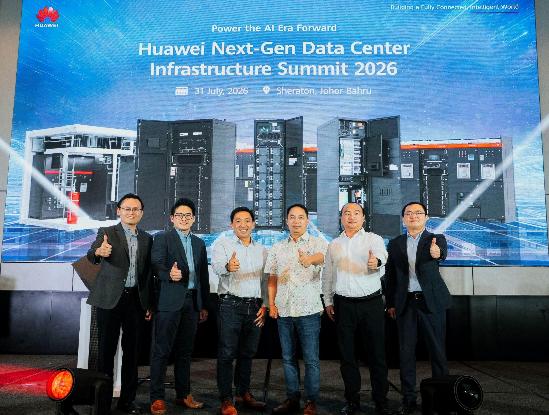
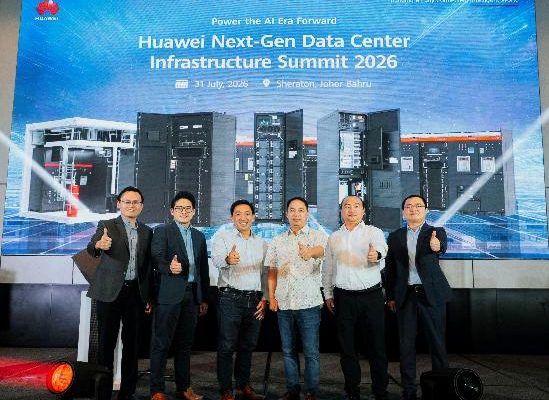
Next-Gen Data Center Infrastructure Summit 2026
The new portfolio was unveiled at the Huawei Next-Gen Data Center Infrastructure Summit 2026, held in Johor Bahru on 31 July 2026. The summit brought together representatives from government agencies, the energy sector, data centre developers, technology organisations and industry leaders to discuss Malaysia’s AI data centre outlook, AI adoption, renewable energy and storage solutions, high-density computing, liquid cooling and next-generation infrastructure.
Industry leaders present included representatives from Invest Johor, the Centre for Technology Excellence Sarawak (CENTEXS), Eden Inc Bhd, DCD Technology Sdn Bhd, NTT Global Data Centers Holding Asia, Pekat Group Bhd, PLANMalaysia Johor, Sarawak Digital Economy Corporation Bhd, Tenaga Nasional Bhd, TM Nxera, CCIE Engineering and Vantage Data Centers.
The “Token Factory” pivot
Huawei Malaysia’s Executive Vice President of Huawei Digital Power, Chong Chern Peng, said the rapid growth of AI workloads is transforming traditional data centres into AI data centres that require higher rack power densities, greater electricity capacity and more advanced cooling capabilities. “This is driving operators to rethink how data centres are designed, built and operated. Every watt of electricity now has to deliver greater value, every system must be more dependable and every facility must be built faster,” he said.
“With these new solutions, we aim to equip data centre owners and operators in Malaysia with the intelligent infrastructure needed to operate efficiently, reliably and sustainably in the AI era,” Chong added. He said Malaysia, particularly Johor, is well-positioned to strengthen its role as a regional data centre hub, driven by growing investments in cloud, hyperscale and AI infrastructure. Huawei sees the shift as the beginning of a “Token Factory” era — where data centres increasingly function like factories that convert electricity and data into AI-generated outputs, with tokens themselves becoming an important measure of how efficiently data centres perform.
The four-solution portfolio
The new portfolio integrates intelligent power supply, battery energy storage and advanced cooling technologies to help data centres operate more reliably, use energy more efficiently and respond more effectively to changing grid conditions while meeting the intensive computing demands of AI.
PowerPOD 5.0 is a prefabricated power system that reduces delivery period for data centre power infrastructure from 60 days to two weeks, enabling operators to bring new capacity online more quickly. Its AI-enabled full-link visualisations help predict operational risks and support preventive maintenance. UPS5000-H-800k is an intelligent power protection solution that provides uninterrupted power to critical equipment during grid fluctuations or outages. Its high-power-density design supports high-density AI computing demands while helping operators use available space more efficiently.
SmartLi 5.0 is an intelligent energy storage solution that supports data centre operations during power disruptions. Its modular architecture allows capacity to be expanded online without interrupting operations, while its cell-to-system protection design is intended to prevent a fault in one battery cell from spreading across the system. Rounding out the portfolio, the TMU provides integrated thermal management for high-powered AI servers. It balances cooling performance with electricity consumption, conducts automatic leak checks and uses predictive maintenance capabilities to flag potential coolant issues before they affect operations.
Our Take
Huawei’s “Token Factory” framing is its clearest articulation yet of how seriously it is taking the AI infrastructure shift. Most operators in Malaysia today still measure data centre performance in megawatts, megawatts per rack, and PUE. The reframing of tokens as the new output metric is a signal that the next generation of AI data centres will be benchmarked on revenue per joule, not just on the power consumed. That is a meaningful philosophical shift, even if the unit economics are still early.
For Malaysian operators, the practical bar is the PowerPOD 5.0 delivery claim: 60 days cut to two weeks. If that holds in real deployments, it materially changes the math for hyperscale and AI buildouts in Johor and Cyberjaya, where the gap between capital commitment and revenue-generating capacity is the single biggest bottleneck. Worth watching the first Malaysian deployments for confirmation before treating the number as gospel. The slot is well-timed too — Johor’s data centre pipeline is the most active in Southeast Asia, and operators are hungry for any vendor that can compress build cycles.
Source: