
Huawei Launches Atlas 960E SuperPoD With First Mass-Produced NPO Optical Engine, Targets 10-Trillion-Parameter Models

TLDR
- Huawei has launched the Atlas 960E SuperPoD, the industry’s first SuperPoD based on its near-package optical (NPO) interconnect
- The system is built on the Hi-ONE optical engine, delivering 7.2 Tbit/s transmission per unit with a built-in light source — a first for the category
- A single Atlas 960E SuperPoD scales to 4,096 NPUs, delivering 8 EFLOPS at FP8 precision and 16 EFLOPS at FP4 precision
- The NPO design cuts optical module count by over 47,000 per SuperPoD, saving more than 550 kW of power and doubling fault-free operating time to 99.8% availability
- Huawei has also opened CANN to sustained community-driven open-source development, aimed at accelerating ecosystem support for the Ascend AI platform
Huawei Unveils The Industry’s First NPO-Based SuperPoD
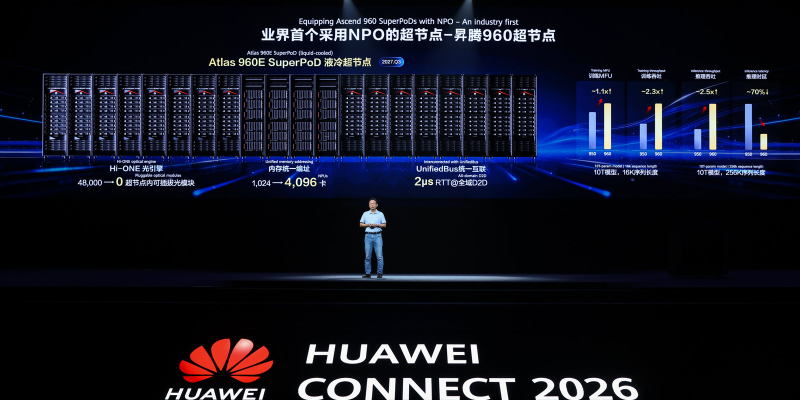
At HUAWEI CONNECT 2026 in Shanghai, Huawei launched the Atlas 960E SuperPoD, a new training and inference system based on the company’s near-package optical (NPO) interconnect technology. The system is targeted at the largest AI training workloads — specifically foundation models approaching 10 trillion parameters — and is designed to address the scaling bottlenecks of traditional optical interconnect architectures.
The launch was led by David Wang, Deputy Chairman of the Board and Rotating Chairman at Huawei, in a keynote that framed the Atlas 960E as the silicon foundation for the agentic world that Huawei is positioning itself around. The shift from conventional pluggable optical modules to NPO is the key technical move that lets the system scale without the power and reliability penalties of the traditional approach.
What NPO Actually Changes
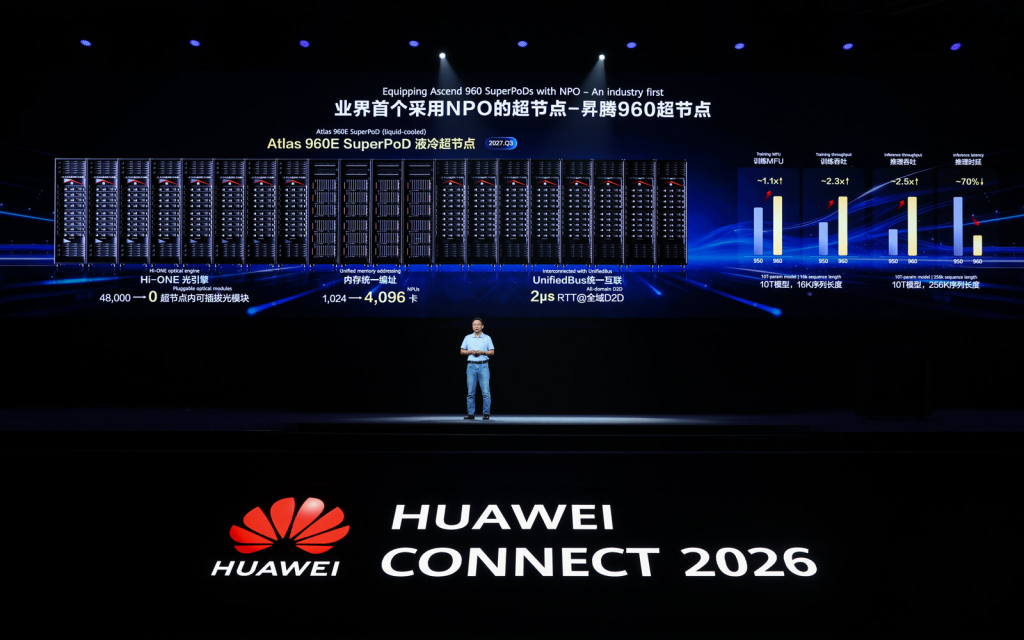
The Hi-ONE optical engine delivers 7.2 Tbit/s of transmission capacity per unit and is the only NPO product on the market with a built-in light source, according to Huawei. The traditional approach to interconnecting thousands of accelerators in a single training cluster relies on hundreds of thousands of 800G optical modules, each with its own power draw and failure mode.
By integrating the optical components closer to the silicon, NPO removes a large number of those discrete modules. In the case of a single Atlas 960E SuperPoD, Huawei says the design uses 5,500 Hi-ONE units instead of the 48,000 800G optical modules a traditional build would require, cutting power consumption by more than 550 kW per system. The reliability impact is significant too: the company is claiming 99.8% system availability, which it attributes to the reduced component count.
Scale And Performance
The Atlas 960E SuperPoD scales to 4,096 NPUs in a single configuration, delivering 8 EFLOPS at FP8 precision or 16 EFLOPS at FP4 precision. For training workloads that need to span multiple SuperPoDs, Huawei’s UnifiedBus networking connects them into a larger SuperCluster with up to 512,000 NPUs, or up to one million NPUs with a multi-rail topology.
Huawei has also applied the same SuperPoD architecture to general-purpose computing with the upgraded TaiShan 950 SuperPoD. That system supports up to 4,096 nodes with a unified memory pool of up to 256 TB, aimed at agent workloads that need large memory capacity. The accompanying OceanStor M900 storage cluster uses UnifiedBus to deliver direct one-hop access and petabyte-scale KV cache for the L3.5 layer, which is the memory tier that agentic systems use for context retention.
CANN Goes Open Source
In parallel with the hardware launch, Huawei used HUAWEI CONNECT 2026 to highlight the open-sourcing of CANN, its Ascend compute platform. Wang positioned the open-source move as essential for ecosystem support: the goal is to make the Ascend platform easier for third-party developers and model providers to adopt, which in turn makes Ascend-based hardware more attractive to enterprise buyers.
For enterprises evaluating AI infrastructure at the trillion-parameter scale, the CANN move matters because it lowers the risk of getting locked into a single vendor’s proprietary stack. Open-source compute platforms that are well supported by the broader model ecosystem are easier to integrate with the rest of the enterprise AI toolchain.
What It Means For The Industry
The Atlas 960E is a statement product rather than a volume product — very few enterprises will run 4,096-NPU training clusters in their own data centres. But the technical moves that make it work (NPO interconnect, Hi-ONE optical engine, the UnifiedBus networking fabric) are exactly the kind of architectural shifts that filter down into smaller-scale systems over time. Hyperscale operators are the immediate buyers, but the broader message is that optical interconnect is the next bottleneck for AI infrastructure scaling, and Huawei is betting that NPO is the answer.
Our Take
Huawei’s SuperPoD play is a credible technical bet that the next bottleneck in AI infrastructure is not compute silicon but the optical interconnect that ties accelerators together. The NPO approach is genuinely differentiated from the conventional pluggable optics that competitors are using, and the 550 kW power saving per SuperPoD is a real number for hyperscale operators thinking about data centre buildouts. Whether the rest of the industry follows Huawei into NPO or stays with conventional optics will depend on whether the supply chain catches up — but the architectural argument is sound.
Versi Bahasa Malaysia: Huawei Melancarkan Atlas 960E SuperPoD Dengan Enjin Optik NPO Pertama Dihasilkan Secara Besar-Besaran, Sasarkan Model 10-Trilion-Parameter