
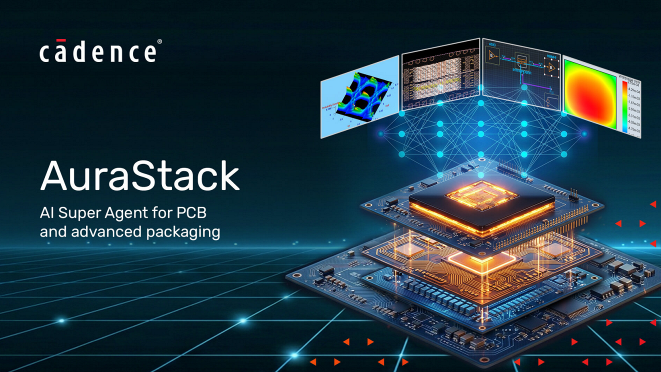
Cadence Launches AuraStack AI Super Agent, the First Agentic AI Platform for PCB and Advanced Packaging

TLDR
- Cadence has launched the AuraStack AI Super Agent on Allegro AI Studio, the first agentic AI platform aimed at PCB and advanced packaging design
- Up to 2X faster time to market and 15X higher productivity via multiphysics-driven design convergence
- Accelerated by NVIDIA Blackwell GPUs and CUDA-X libraries, orchestrating AI agents across planning, implementation and analysis
- Unifies Cadence multiphysics signoff solvers — Celsius, Clarity 3D Solver, MSC Nastran, Marc and Sigrity X
- Industry collaborators already on board: NVIDIA, TSMC, Socionext, FORVIA HELLA and Schneider Electric
- Generally available in 2026
Cadence Adds a System-Level AI Agent to Its EDA Stack
Cadence has introduced the AuraStack AI Super Agent on its Allegro AI Studio platform, positioning it as the world’s first agentic AI solution dedicated to printed circuit board and advanced packaging design. The launch extends Cadence’s agentic AI portfolio, which already includes the ChipStack, InnoStack and ViraStack AI Super Agents for digital and analog silicon design, making Cadence the only EDA vendor with an agentic AI layer spanning the full silicon-to-system design flow.
The AuraStack AI Super Agent is accelerated by NVIDIA Blackwell GPUs and CUDA-X libraries. It coordinates domain-specific AI agents across planning, implementation and tightly integrated multiphysics analysis domains, compressing the system-design cycle through manufacturing. According to Cadence, the platform delivers up to 2X faster time to market and 15X higher productivity compared to traditional manual workflows.
Agentic AI for Packaging and PCB Design
The AuraStack AI Super Agent combines automation and optimisation tools with a mental model of the design intent, automating and orchestrating design exploration, realisation and signoff. It brings together capabilities across system planning, constraints management, physical structure definition, IP creation and reuse, place and route, design for manufacturability and multiphysics analysis.
The platform introduces a unified, AI-driven multiphysics foundation that concurrently models and optimises electrical, thermal and mechanical behaviour — including signal and power integrity, thermal, mechanical stress, drop, vibration and fatigue analysis — within a closed-loop environment. This continuous multiphysics feedback loop enables real-time design convergence, reducing late-stage surprises and improving overall system reliability.
Industry Leaders Deploying AuraStack Workflows
Cadence has lined up a roster of industry collaborators to validate real-world deployment of the AuraStack AI Super Agent across advanced IC packaging and PCB design workflows. NVIDIA is using Cadence to automate and optimise increasingly complex system design workflows. According to Tim Costa, vice president and general manager of computational engineering at NVIDIA, the collaboration is delivering up to 20X faster multiphysics performance when pairing AuraStack with NVIDIA’s Millennium M2000 Supercomputer.
TSMC is partnering with Cadence to accelerate advanced package implementation through AI-driven automation. Aveek Sarkar, director of the Ecosystem and Alliance Management Division at TSMC, noted that the multi-year collaboration on substrate auto routing is already enabling customers to boost productivity by 100X while delivering quality of results similar to manual routing. Socionext is leveraging AuraStack to automate and optimise complex semiconductor package and PCB design workflows, while FORVIA HELLA is using AI-assisted placement technology to compress a 300-component placement task from four days to four minutes.
Schneider Electric is applying AI-driven design automation to scale institutional knowledge across engineering teams. Daniel Gheno, senior vice president of Innovation and Technology EM at Schneider Electric, framed the collaboration as more than a productivity tool: the next frontier is combining design automation with engineering expertise so decades of know-how can be made available to every engineer.
Our Take
The AuraStack AI Super Agent is the clearest signal yet that agentic AI is moving from silicon design into the messy reality of PCB and package layout, where thermal, mechanical and signal integrity constraints collide. For Malaysian readers, the impact is indirect but real: every advanced AI accelerator, automotive controller and hyperscale data centre board flowing through TSMC’s 3DFabric pipeline benefits from these tools in some form, even if the design teams themselves sit in California, Taiwan or Germany rather than Penang.
The bigger question is whether agentic AI can hold up on the signoff side, where multiphysics convergence is non-negotiable. Cadence’s choice to anchor AuraStack on its established solvers — Celsius, Clarity, Nastran, Marc and Sigrity — is the right hedge: the AI agent orchestrates exploration, but the physics still come from tools engineers already trust. That dual-track approach is what separates serious platforms from demos.
Source
Versi Bahasa Melayu: CubaTek — Cadence Pelancar AuraStack AI Super Agent