

Microsoft Unveils MAI-Cyber-1-Flash, Its First Homegrown Cybersecurity AI Model

TLDR
- Microsoft just shipped MAI-Cyber-1-Flash — its first homegrown cybersecurity AI model
- Built in-house on the MAI-Thinking-1 lineage, tuned for code-heavy vulnerability workflows
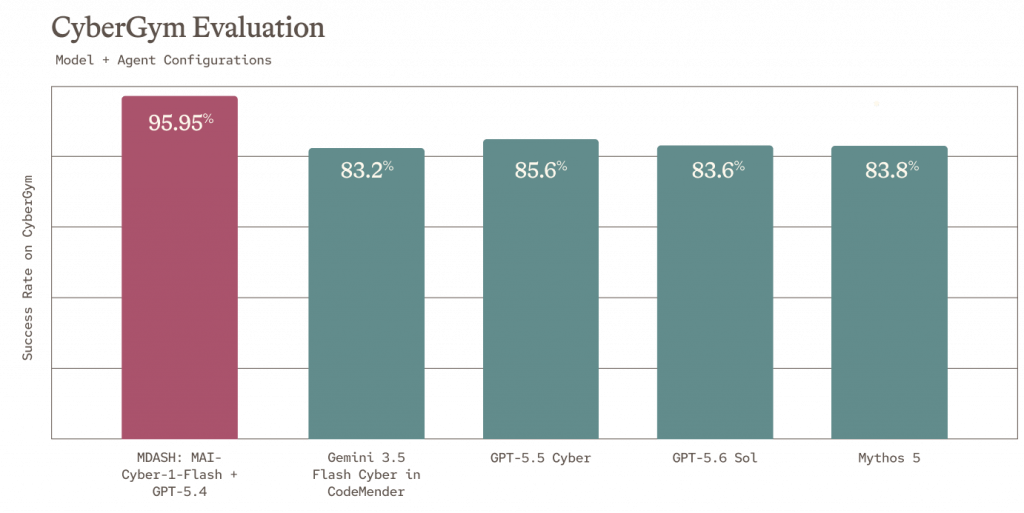
- Hits 96% on the CyberGym benchmark, beating Anthropic’s Mythos by 12 points
- Cuts Microsoft Defender’s MDASH security stack cost by roughly 50%
- Goes into public preview on 3 August 2026 inside the new Project Perception agentic system
Microsoft has unveiled MAI-Cyber-1-Flash, the company’s first cybersecurity model built entirely in-house rather than licensed from OpenAI. The compact, code-heavy model is derived from the MAI-Thinking-1 lineage, a family Microsoft trained from scratch on its own curated data, and is designed to handle the bulk of vulnerability detection, triage and remediation work that floods enterprise security teams every day.

What makes the launch significant is the strategic shift behind it. Microsoft has spent years leaning on OpenAI’s GPT family for its Defender, Security Copilot and MDASH products. MAI-Cyber-1-Flash is the first signal that Microsoft AI — the in-house lab run by Mustafa Suleyman — is now producing its own frontier-class models for security workloads. The model is trained on what Microsoft calls an “unmatched record of real exploits and remediations” — decades of vulnerability data, threat intelligence and remediation history that no other lab can replicate.
Beating Mythos at Half the Cost
The benchmark headline is striking. On CyberGym — an industry-leading test for AI vulnerability identification — MAI-Cyber-1-Flash scores 96%, putting it 12 points ahead of Anthropic’s Mythos. More importantly, when plugged into MDASH (Microsoft’s multi-agent vulnerability harness), the new model cuts the cost of running that pipeline by roughly 50% compared to today’s GPT-5.4-based configuration.
The cost saving matters because cyber workloads are uniquely token-heavy. A single enterprise scan can produce millions of code chunks to analyse, and most are routine patterns that don’t need a frontier-sized model. Microsoft’s bet is that routing those routine tasks through a smaller, specialised model — and reserving GPT-5.4 for the genuinely hard 10% — delivers better economics without compromising detection quality.
The Multi-Model Strategy Behind Project Perception
MAI-Cyber-1-Flash isn’t launching as a standalone product. It’s the first specialised model wired into Project Perception, Microsoft’s new agentic security system that enters public preview on 3 August 2026. Perception coordinates red team agents (which hunt for compromise paths), blue team agents (which investigate and reason over risk) and green team agents (which remediate and harden the environment) into a closed-loop, continuously learning defence stack.
The architecture is deliberately multi-model. Rather than betting everything on one model, Perception picks the best tool for each task — frontier models like GPT-5.4 for the hardest reasoning, MAI-Cyber-1-Flash for the routine security work, and specialised agents for orchestration. Microsoft calls this “the right model at the right price for every task”, and it’s a notable departure from the single-model Security Copilot pitch of two years ago.
What It Means for Defenders
For Malaysian and Southeast Asian enterprises already running Microsoft Defender, the practical impact is real but incremental. The same MDASH pipeline now costs half as much to operate, which means Microsoft can afford to expand coverage — more frequent scans, deeper code analysis — without raising subscription prices. Customers should expect Defender and Security Copilot pricing to stay flat, with more capability per dollar, rather than aggressive discounts.
Our Take
Microsoft has been talking about “AI to defend against AI” for two years, but MAI-Cyber-1-Flash is the first model that actually delivers on the pitch with credible numbers. The 96% CyberGym score and 12-point lead over Mythos aren’t marketing fluff — that’s a real benchmark lead from a respected test suite, and the 50% cost saving is structurally believable given the multi-model routing design.
That said, the usual caveats apply. CyberGym measures vulnerability identification, not the harder problem of exploit reasoning or zero-day discovery. Microsoft’s training data advantage is genuine but also means the model inherits every bias and blind spot in that historical record. And the “first cyber model” framing conveniently obscures how much of Microsoft’s security stack still runs on OpenAI GPT under the hood.
For Malaysian businesses, the practical takeaway is straightforward: if you’re a Microsoft Defender shop, this is unambiguously good news — better detection at lower cost, arriving in your tenant on 3 August. If you’re running a multi-vendor security stack, treat this as a benchmark to pressure your incumbent vendors with.