
China Mass-Produces Homegrown DUV Lithography Machines in Direct Shot at ASML

TLDR
- China’s Shanghai Micro Electronics (SMEE/Aishengna) has started mass-producing domestic immersion DUV lithography tools
- ASML shares slid up to 6.6% on the news as investors priced in real competition for advanced chipmaking gear
- The breakthrough targets the 28nm-class node, where ASML still owns the global market for high-end lithography
- A US bill to keep more chipmaking equipment out of China has reportedly been scaled back, reducing pressure on Beijing
- Malaysian OSAT players in Penang and Kulim face downstream ripple effects as China’s chip tool stack matures
China Cracks the Lithography Stack
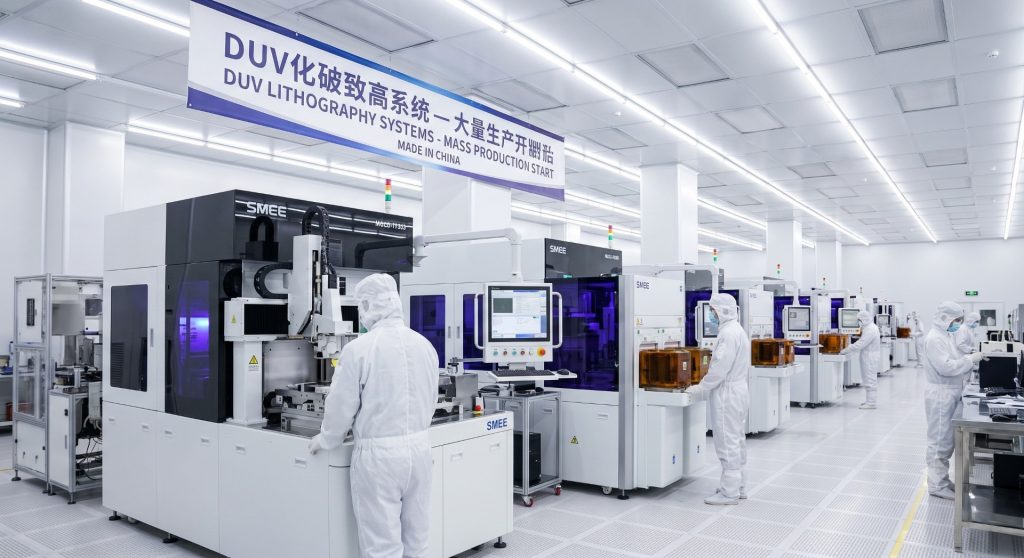
For the first time, China has begun mass producing domestically developed immersion deep-ultraviolet (DUV) lithography machines — the workhorse tools that print the smallest features on silicon wafers for everything from electric vehicles to AI accelerators. Reuters broke the story on 28 July, citing a person familiar with the rollout, and identified the Shanghai state-backed startup behind the line as Shanghai Micro Electronics (SMEE), operating under the Aishengna brand.

DUV immersion lithography is the gatekeeper technology for chips at the 28nm node and below. Until now, Dutch giant ASML effectively owned that market outside China, with Japan’s Nikon and Canon filling in older dry-DUV slots. SMEE’s homegrown immersion tool signals that Beijing’s multi-decade, multi-billion-dollar push to localise chipmaking equipment is finally crossing the line from prototype to production floor.
ASML and the Export-Control Equation
The news hit ASML hard. The Veldhoven-based equipment maker saw its shares drop as much as 6.6% on 27 July as the market priced in real — not hypothetical — Chinese competition for the high-volume segment of lithography. ASML’s last defensible moat is extreme ultraviolet (EUV) lithography, used for the most advanced 7nm, 5nm and 3nm nodes. China is still believed to be years away from a production-grade EUV system.
Adding context: a US bill designed to tighten the screws on Chinese access to chipmaking equipment has been scaled back, according to a separate Reuters report. The original draft pushed for sweeping restrictions on more legacy categories; the revised version narrows the scope. For Beijing, the timing could hardly be better — domestic tools are ramping just as Washington’s chokehold loosens.
What the Tools Can (and Can’t) Do
Industry analysts quoted across coverage remain cautious. SMEE’s immersion DUV is not a 1:1 replacement for ASML’s Twinscan NXT series. Throughput, overlay accuracy and defect density all matter in a fab, and Chinese fabs have historically run imported machines even when domestic alternatives existed. But the gap is closing fast, and SMEE has reportedly secured initial orders from at least one domestic foundry.
The strategic significance is bigger than any single chip node. With lithography — historically the hardest tool to crack — now entering domestic production, China moves closer to a self-sufficient front-end equipment stack. That changes the calculus for everyone downstream, including the back-end packaging and assembly houses that finish chips after the wafer fabs are done.
Our Take
For Malaysian semiconductor players, the story is mostly indirect but real. Penang and Kulim host the world’s largest concentration of OSAT (Outsourced Semiconductor Assembly and Test) facilities — operators like ASE, Inari, ViTrox and Mi Equipment. Their business depends on wafer fabs shipping them advanced chips to package. If Chinese fabs gradually shift from ASML tools to domestic alternatives, the volume and mix of wafers flowing into the Chinese ecosystem could shift too, reshaping where Malaysian OSATs sit in the global supply chain.
It also reframes the regional tech race. The narrative used to be that China was perpetually “five years behind” on lithography. That line no longer fits. Even if SMEE’s tools are a generation behind ASML’s best, mass production means iteration, learning curves and shrinking cost gaps. The next decade of Asian chipmaking is going to be fought on equipment independence, and the contest just got a lot more crowded.