
Lenovo Hits 90% Renewable Energy in Global Operations, Unveils New ESG Aspirations in FY2025-26 Report

TLDR
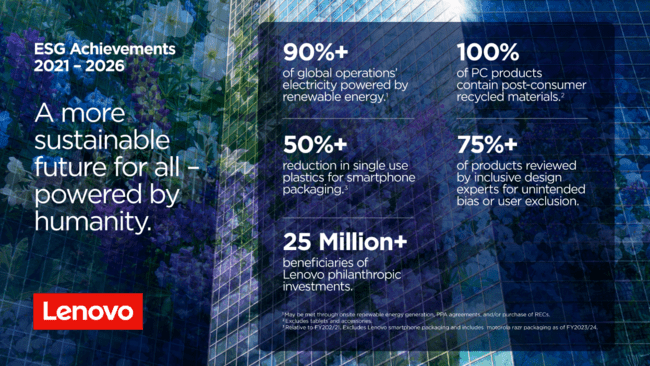
- Lenovo’s FY2025-26 ESG Report, released 28 July 2026, confirms over 90% of its operations electricity now comes from renewable sources
- The company remains on track for net-zero by 2050, with targets validated by the Science Based Targets initiative
- 100% of Lenovo PC products now incorporate post-consumer recycled materials, with 800M+ lbs of e-waste recovered since 2005
- Philanthropy programmes have positively impacted more than 25 million people between 2021 and 2026
- Lenovo also unveiled a new generation of ESG aspirations alongside the report, with AI governance as a central pillar
A Cleaner Grid for Lenovo’s Operations
Lenovo has crossed a meaningful threshold in its decarbonisation journey. The company’s FY2025-26 ESG Report, released on 28 July 2026, confirms that more than 90% of Lenovo’s global operations’ electricity now comes from renewable sources — a combination of onsite generation, power purchase agreements, and renewable energy certificates. The company remains on track to reach net-zero emissions by 2050, with its targets validated by the Science Based Targets initiative.

The figure is more than a PR line. Reaching 90% renewable electricity across a global manufacturing and R&D footprint means Lenovo has rewritten the energy contracts behind millions of devices shipped every year. For a PC and server maker operating more than 30 manufacturing sites across 10 markets, the operational work to get there — rewiring facilities, signing multi-year PPAs, and tracking Scope 2 emissions by site — is the unglamorous backbone of the headline number.
Designing for the Circular Economy
Circularity is where the report gets most concrete. Under the R.E.A.L Framework — repairability, reuse, and recycling — Lenovo reports that 100% of its PC products now incorporate post-consumer recycled materials (excluding tablets and accessories). The company has enabled more than 800 million pounds of end-of-life product recovery since 2005 and reused 300 million pounds of post-consumer recycled plastics in the same window. Smartphone packaging has been reworked too: 60% recycled materials and a 50% reduction in single-use plastics compared to FY2020/21.
These are not aspirational targets; they are audited outcomes. For Malaysian buyers, the implications land directly in the recycling stream — the device you trade in or scrap today is part of the same recovery pipeline the report is tallying.
People, Community, and the AI Era
Lenovo’s social impact numbers are unusually large for a hardware company. From 2021 to 2026, the company’s philanthropy programmes positively impacted more than 25 million people through expanded access to technology and education. Employee volunteer programmes such as Love on Month of Service hit record engagement over the reporting period. Representation of women and underrepresented groups across the global workforce has also measurably improved, with external recognition from Disability:IN, Workplace Pride, the Human Rights Campaign Corporate Equality Index, and Forbes.
The AI dimension runs through the report too. Lenovo is positioning its “smarter AI for all” approach as a tool for sustainability itself — using AI to measure, analyse, and optimise environmental metrics — while also pushing AI-for-good initiatives including the TRAdA solution for predicting heart arrhythmia in athletes, accessibility tools such as communication avatars and sign language translation, and global AI skilling partnerships with Tech To The Rescue and Ashoka. AI governance, Lenovo argues, is the next ESG front line, and the company is leaning into industry coalitions like the ITU AI Skills Coalition and the Coalition for Sustainable AI to help set the standards.
Awards and What Comes Next
External recognition has been accumulating. The FY2025-26 report highlights an EcoVadis Platinum Medal, CDP A List for both climate and water alongside an A rating for supplier engagement, a spot on Corporate Knights’ 100 Most Sustainable Companies, #5 in Gartner’s 2026 Global Supply Chain Rankings, and the Hong Kong Institute of Certified Public Accountants’ “Most Sustainable Organization” award.
As Lenovo closes out its first generation of long-term ESG aspirations, the company has now announced a new set of targets to carry it through the back half of the decade. The full breakdown is in the FY2025-26 ESG Report.
Our Take
Lenovo’s report is heavy on volume and light on drama, which is actually the right register for an ESG update. Hitting 90% renewable electricity is a real milestone, and the 100% PCR materials claim for the PC lineup is one of the more aggressive circular commitments in the global hardware industry. The 25 million people positively impacted figure is large enough to deserve scrutiny, but the underlying programmes — philanthropy, education access, volunteer hours — are the kind of work that scales legitimately when paired with a manufacturing footprint Lenovo has.
The more interesting strategic move is the explicit framing of AI governance as an ESG pillar. Most hardware companies still treat AI as a product story, not a sustainability one. Lenovo is arguing that the two are now inseparable — and that the same company that manages a 90% renewable electricity footprint should also be the one setting the rules for how AI gets deployed responsibly. That narrative is worth watching as the next generation of ESG aspirations plays out through 2030.