
AIXTRON Opens Penang Facility, Targets 150 Jobs in Compound Semiconductor Push

TLDR
- German deposition equipment maker AIXTRON SE is now actively hiring for its new Penang facility, with around 150 roles targeted by end-2026
- The site will focus on compound semiconductors — Gallium Nitride (GaN), Indium Phosphide (InP) and Silicon Carbide (SiC) — used in AI power and data infrastructure
- AIXTRON frames the bet as a play on the “AI Power Wall” and “AI Data Wall”, tackling power conversion and high-bandwidth optical interconnects in one move
- MIDA CEO Datuk Sikh Shamsul Ibrahim Sikh Abdul Majid toured the company’s Herzogenrath HQ on July 22, calling the investment a direct match for Malaysia’s National Semiconductor Strategy
- The Penang plant slots into Malaysia’s target of training 60,000 high-skilled semiconductor professionals by 2030 and widens the country’s front-end equipment footprint beyond back-end assembly
AIXTRON Plants Its Flag in Penang
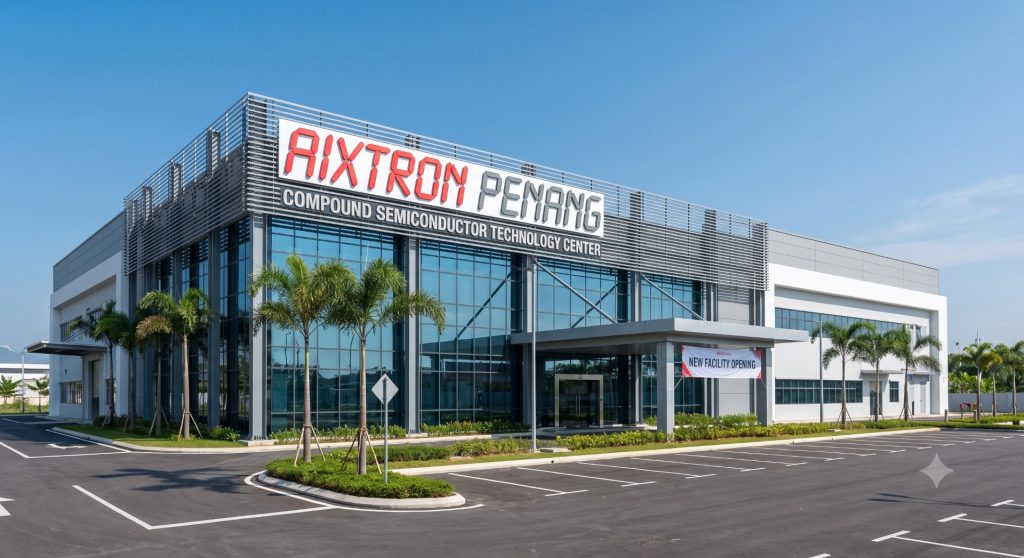
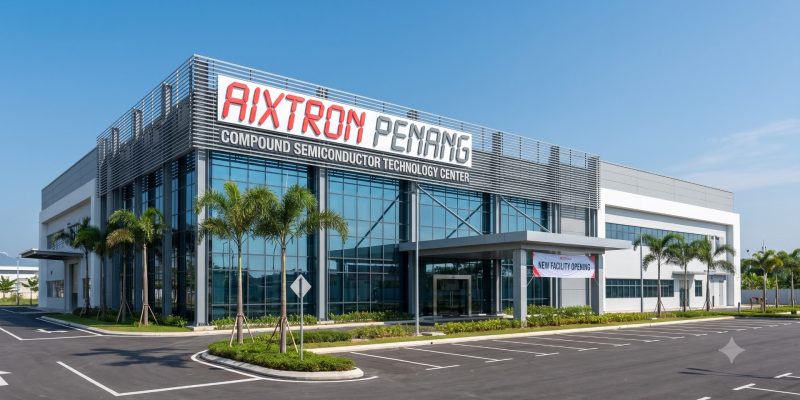
AIXTRON SE, the German maker of metal-organic chemical vapour deposition (MOCVD) systems that quietly underpins much of the world’s compound semiconductor output, has officially shifted into hiring mode for its new Penang facility. The Herzogenrath-headquartered company confirmed on July 23 that around 150 roles — spanning engineering, manufacturing, and a new Customer Service Support Center — will be filled locally before the year wraps.

For a country that has long been the world’s back-end champion of assembly, test, and packaging, the arrival of a front-end deposition equipment manufacturer on Malaysian soil is a meaningful upgrade to the industrial map. AIXTRON’s reactors are the machines that grow the actual GaN, InP, and SiC crystal layers that end up in everything from electric vehicle inverters to 800-volt data centre power supplies and the laser diodes inside optical transceivers.
Why Compound Semis, Why Now
The facility is being framed less as a generic capacity play and more as a targeted answer to two constraints the AI buildout keeps running into. AIXTRON calls them the “AI Power Wall” and the “AI Data Wall” — the twin bottlenecks of energy-hungry training clusters and the need to move ever-larger volumes of data between accelerators, memory, and storage.
GaN-on-SiC and pure SiC deposition runs feed high-efficiency power conversion for hyperscale data centres, EV fast-charging, and grid-tied energy storage, all of which Malaysia’s industrial corridors are increasingly asked to host. InP-based epitaxy, meanwhile, is the workhorse behind the high-speed lasers that ship inside 800G and emerging 1.6T optical transceivers — the connective tissue of every modern AI fabric. Bringing the deposition toolset physically closer to South-East Asia’s packaging and assembly clusters shortens feedback loops between process engineers and customers, which is the kind of lead time advantage that matters when node cycles keep compressing.
MIDA’s Bet on a Front-End Player
On July 22, Malaysian Investment Development Authority (MIDA) CEO Datuk Sikh Shamsul Ibrahim Sikh Abdul Majid flew to AIXTRON’s German headquarters to see the production lines firsthand. The visit signals how seriously Putrajaya is taking the next rung of the semiconductor value chain. MIDA tied the investment directly to Malaysia’s National Semiconductor Strategy, which is chasing roughly RM500 billion in targeted investments and, crucially, a 60,000-strong high-skilled semiconductor workforce by 2030.
AIXTRON’s local hiring pipeline — process engineers, equipment technicians, field service engineers, applications support — will be one of the most direct private-sector contributions to that headcount target. For Penang specifically, it also strengthens the northern cluster’s pitch as a full-stack semiconductor hub, sitting alongside the OSAT giants in Bayan Lepas, the wafer work at Kulim Hi-Tech Park, and the advanced packaging build-outs that TSMC subsidiary Xintec is pushing across the Kedah border.
Our Take
AIXTRON’s Penang bet is a small but symbolic shift in Malaysia’s semiconductor story. The country has spent decades getting very good at the back half of the chip lifecycle, and for a long time that was the smart play. But as the AI buildout increasingly strains both power delivery and data movement, the strategic premium is moving upstream — toward the deposition tools and process know-how that determine whether a fab can even hit yield on a GaN or InP wafer. Landing a top-tier front-end equipment OEM in Penang is a vote of confidence in that direction.
For Malaysian engineers and fresh graduates, the 150 roles are a real on-ramp into a part of the industry most locals have historically had to leave the country to access. For the wider ecosystem, the question now is whether this is the first domino — GlobalFoundries, Lam Research, Applied Materials, and Tokyo Electron all have reasons to want a Penang or Kulim footprint if AIXTRON’s bet works out. Watch the MIDA pipeline over the next two quarters.