
TSMC Pledges Additional US$100 Billion in US Chip Manufacturing, Lifting Arizona Commitment to US$265 Billion

TLDR
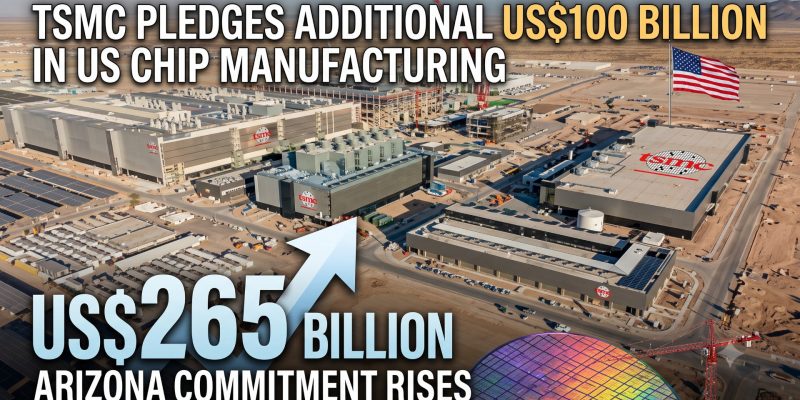
- TSMC commits an additional US$100 billion to Arizona fabs and advanced packaging, lifting its total US investment to US$265 billion across 12 facilities.
- The expansion adds four new semiconductor manufacturing and packaging plants on top of the eight already planned in Phoenix.
- It is officially the largest foreign direct investment in US history, anchored by the January 2026 US-Taiwan trade and investment deal.
- The buildout is driven by multi-year demand from leading US customers, primarily AI accelerator and HPC chip designers.
- For Malaysia, the deal reinforces Penang’s role as the back-end packaging and equipment hub that supports TSMC’s global supply chain.
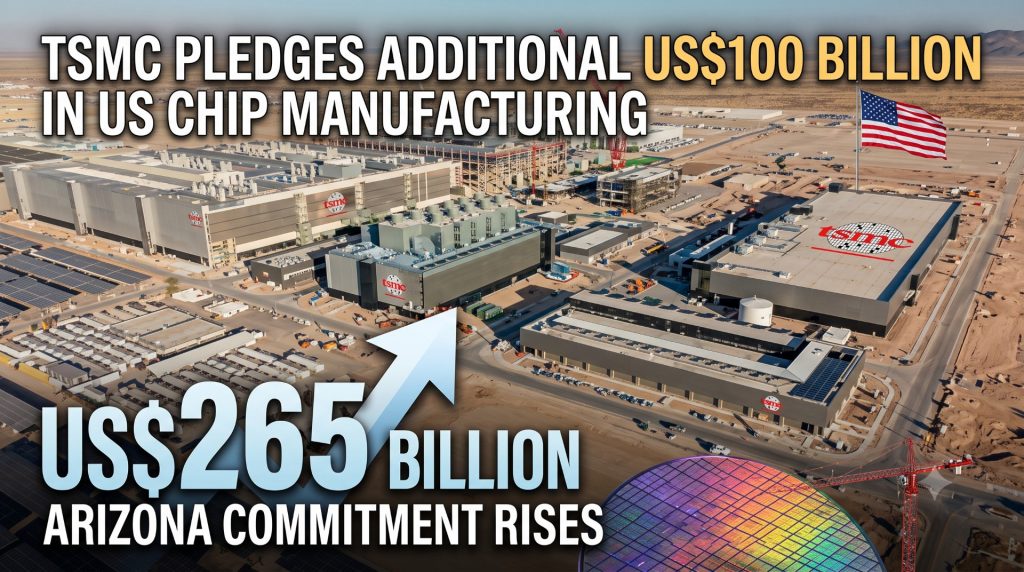
Taiwan Semiconductor Manufacturing Company has committed an additional US$100 billion to its United States semiconductor manufacturing operations, lifting its cumulative American investment to a record US$265 billion. The White House and the US Department of Commerce jointly announced the incremental pledge on 16 July 2026, framing it as the direct outcome of the historic US-Taiwan trade and investment deal brokered earlier this year through the American Institute in Taiwan.
The new tranche will fund four additional leading-edge fabrication plants and advanced packaging facilities in Arizona, bringing TSMC’s total US site count to 12. Commerce Secretary Howard Lutnick called it a clear win for domestic manufacturing, while TSMC Chairman Dr C.C. Wei pointed to “strong multi-year demand from our leading US customers” as the underlying engine. The announcement follows TSMC’s record-breaking Q2 results, which comfortably exceeded analyst forecasts.
What the Extra US$100 Billion Actually Buys
The latest capital injection is not a token expansion. Industry analysts at Supply Chain Dive noted that the four new Arizona facilities will focus on advanced-node logic production alongside chip-on-wafer-on-substrate (CoWoS) packaging, the exact bottleneck segments currently throttling AI accelerator supply worldwide. By co-locating leading-edge fabs with advanced packaging lines in Phoenix, TSMC is building a vertically integrated US manufacturing cluster capable of producing and packaging cutting-edge AI silicon entirely on American soil.
The scale also resets the bar for foreign direct investment. With US$265 billion in committed capital, the project is officially the largest single FDI in US history. Tens of thousands of high-tech jobs are expected to follow, along with billions in indirect economic output. The deal also includes US$250 billion in direct Taiwanese semiconductor investments and a further US$250 billion in supporting supply chain investment, creating a multiplier effect that will reshape North American chipmaking for the next decade.
Why ASEAN and Malaysia Should Pay Attention
The deal may be billed as a US-Taiwan story, but the ripple effects land directly on Malaysian shores. Penang’s semiconductor cluster, which already hosts back-end assembly, test and equipment manufacturing for nearly every major foundry, is positioned to absorb spillover demand as TSMC’s Arizona fabs ramp. The RM4.9 billion in approved manufacturing investments Penang recorded in Q1 2026 was already running well ahead of historical averages, and the TSMC announcement gives local OSAT players and equipment vendors a clear multi-year demand signal.
Back-end packaging specialists in Kulim and Batu Kawan stand to benefit most, as capacity constraints in CoWoS and similar advanced packaging flows remain the single biggest gating factor for AI chip rollouts. Recent Malaysian facility openings, including MKS Instruments’ Supercenter Factory in Batu Kawan and AIXTRON’s new Penang plant, show that global semiconductor suppliers are already positioning for exactly this kind of upstream expansion.
Our Take
The TSMC US$265 billion commitment is a watershed moment for the global semiconductor industry, but the most interesting story for Malaysian readers is what happens downstream. While headlines focus on Arizona fabs and US industrial policy, the practical reality is that no foundry buildout of this scale ships without deep support from Southeast Asian back-end and equipment partners, and Penang is the closest and most capable node in that network.
Local vendors should treat the next 24 months as a critical window. TSMC’s Phoenix cluster will need mature back-end capacity to handle CoWoS overflow, and Malaysian OSAT players with proven high-volume packaging expertise are the natural first call. For policymakers, the message is clear: defend the foreign engineer pathways that keep the cluster competitive and resist any drift toward protectionism that would shut MY suppliers out of the most lucrative advanced-packaging flows. Done right, Penang walks away from this cycle as the indispensable second engine of the US-Taiwan semiconductor axis.