


WD Malaysia Recognized for Advancing Sustainable AI Infrastructure

Western Digital’s Malaysia operations have been formally recognised for advancing sustainable AI infrastructure, putting the country’s largest storage manufacturer on a short list of vendors racing to keep the data centre boom from turning into a climate problem.

TLDR
- WD Malaysia picked up a sustainability award tied specifically to AI infrastructure, not generic ESG reporting
- The recognition comes as Malaysia’s data centre pipeline pushes hard drive demand to record highs
- Storage is the unglamorous carbon problem of AI — every training run and inference query has to land on a disk eventually
- WD’s Penang footprint (Batu Kawan) is one of the few places outside the US and Japan where enterprise drives are physically built
- The win matters because hyperscalers increasingly factor vendor sustainability scores into procurement, not just price
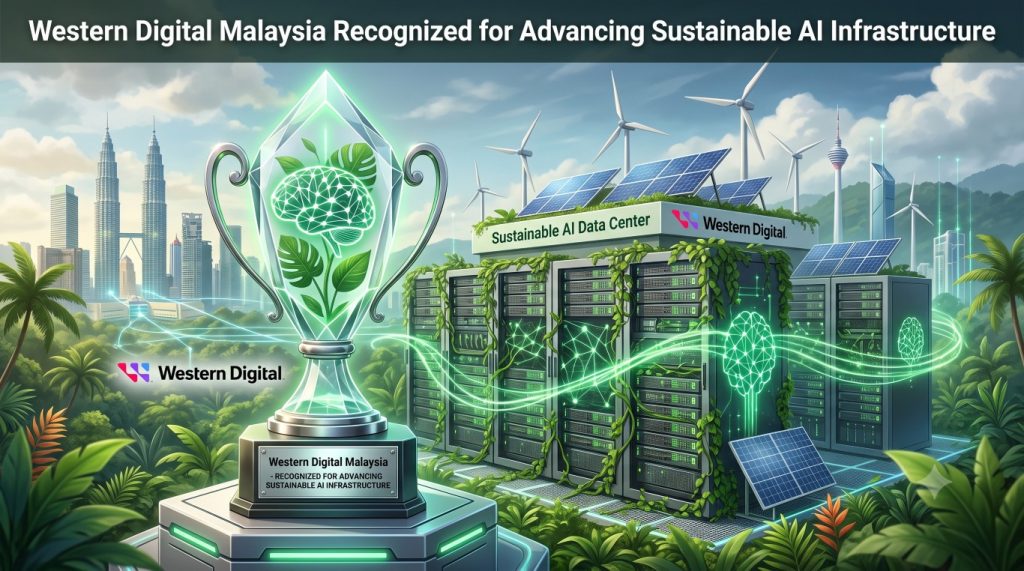
The award is not your typical “we recycled some paper” corporate trophy. It singles out WD’s work in making the underlying storage layer of AI infrastructure — the racks of hard drives and SSDs that hold training data, model weights, and inference logs — measurably more energy and material efficient. That is a meaningful distinction because AI’s carbon footprint story usually focuses on GPUs and cooling, not the petabytes of spinning rust that hold everything together.
Malaysia is the natural home for this kind of work. Western Digital operates one of its largest hard drive manufacturing campuses in Batu Kawan, Penang, and has been expanding SSD assembly capacity in the country for several years. According to the company’s own disclosures, the Penang site handles a significant share of global enterprise drive output. When a vendor that big makes a sustainability commitment, the leverage on the supply chain is enormous — a few percentage points of efficiency at WD Malaysia scale translates into real terawatt-hours saved.
The Sustainability Numbers That Actually Count
What separates serious sustainability work from PR is whether you publish the boring metrics — power usage effectiveness, water per drive, recycled content in aluminium housings, scope 3 emissions from upstream rare earth refining. WD has been progressively disclosing these across its operations, and the Malaysia recognition tracks against the company’s broader 2030 climate targets rather than a one-off project.
For Malaysian readers, the practical angle is jobs and investment. WD has thousands of employees in Penang, and the company has signalled continued capex into the site as AI storage demand surges. Sustainability awards are useful marketing, but they also lock in customer commitments — hyperscalers like Microsoft, Google, and AWS now publish supplier scorecards, and a recognised vendor with a Malaysian manufacturing footprint has a structural advantage when those buyers diversify away from single-country concentration risk.
The Uncomfortable Counter-Argument
It is worth being honest about the optics here. Storage is a necessary part of AI, but AI itself is the demand driver — every model retrain, every ChatGPT query, every Copilot suggestion adds to the disk fleet. WD making drives slightly more efficient does not reduce the total energy footprint of the AI build-out. It just slows the growth rate. If the world’s AI infrastructure doubles in capacity over the next three years, as most forecasts suggest, even double-digit percentage efficiency gains on the storage side will be dwarfed by raw volume growth.
That said, this is still the right direction. The alternative — ignoring efficiency and just building more capacity — is worse. And vendor-level recognition matters because it sets procurement expectations. If WD’s competitors (Seagate, Toshiba, Samsung) have to match these scores to win hyperscaler contracts, the entire industry moves.
Our Take
WD Malaysia’s recognition is a credible win, not just a press release with a ribbon on it. The company has real Malaysian manufacturing exposure, the award is tied to a specific technical problem (storage efficiency for AI workloads), and the customer side actually cares about these metrics now. We give it a guarded thumbs up — guarded because no storage efficiency improvement cancels out the underlying AI demand curve, but thumbs up because this is how industrial decarbonisation actually happens, one boring component at a time.
For Malaysia, the story is also quietly important: it reinforces the country’s position as a critical node in the global AI hardware supply chain. Penang does not get the headlines that TSMC’s Arizona fab does, but it makes the drives that hold the models those fabs train. That is real, and it is worth recognising.
Keyword
Keyword: WD Malaysia sustainable AI infrastructure