
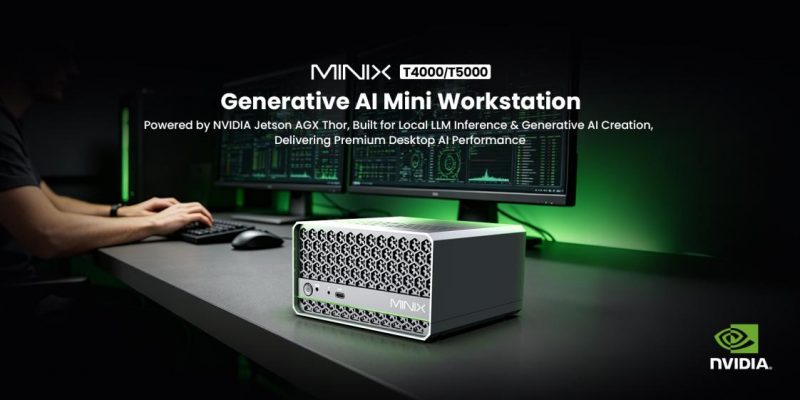
MINIX Launches T4000 and T5000 Generative AI Mini Workstation — NVIDIA Blackwell, Local LLM Inference Up to 70B Parameters

TLDR:
- MINIX T4000 and T5000 mini workstations feature NVIDIA Jetson AGX Thor modules with Blackwell architecture
- T4000: 1200 Sparse FP4 TFLOPs AI performance; T5000: Up to 2070 Sparse FP4 TFLOPs
- Native support for 7B–70B parameter LLM inference locally — no cloud required
- 12-14 core Arm Neoverse-V3AE CPU, up to 128GB LPDDR5X, dual 10GbE, compact 139×131×76.8mm chassis
- Pre-installed Ubuntu 24.04 LTS with NVIDIA JetPack 7.1, full CUDA/TensorRT support
Next-Generation On-Premise AI Computing
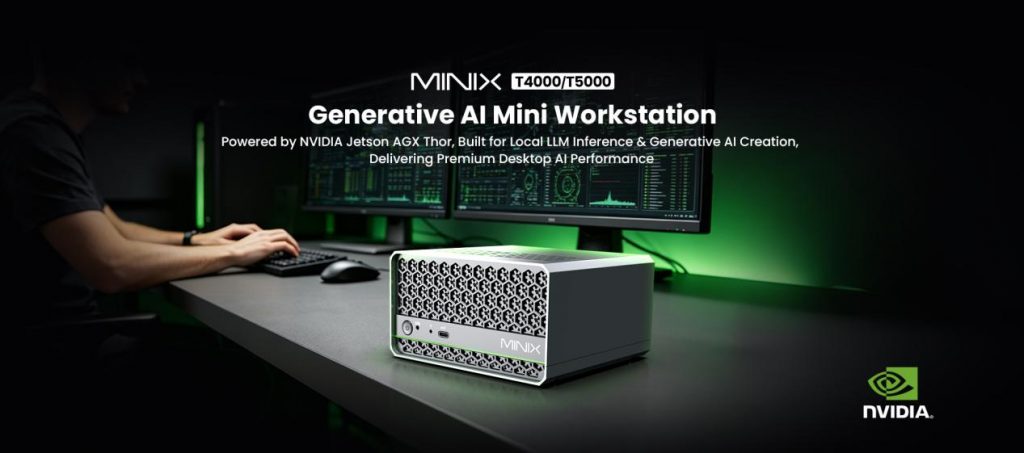
MINIX has announced the T4000 and T5000 Generative AI Mini Workstation — compact desktop systems built around NVIDIA’s Jetson AGX Thor platform with Blackwell architecture. The new workstations target professionals, developers, creators, and IT teams who need substantial AI computing power without the space requirements of traditional server hardware.
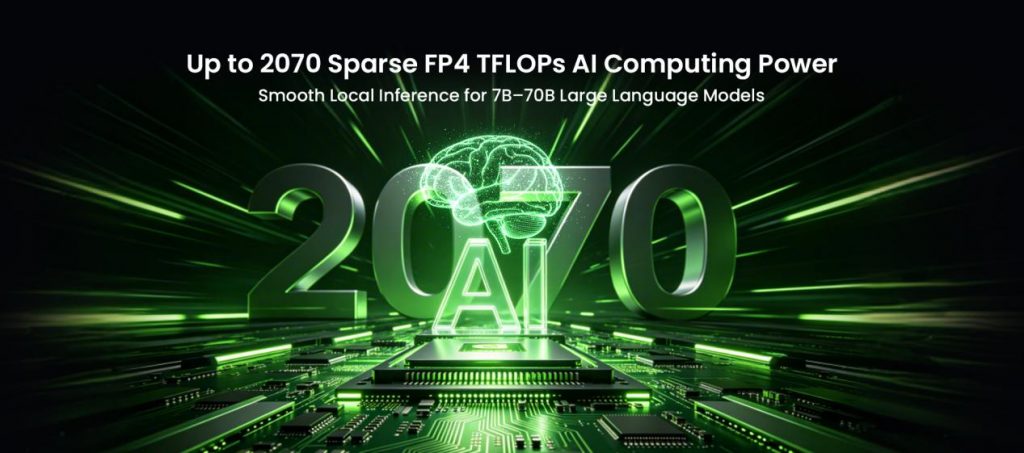
The T4000 delivers 1200 Sparse FP4 TFLOPs of AI performance while the T5000 scales up to 2070 Sparse FP4 TFLOPs. Both systems feature the Blackwell GPU architecture with fifth-generation Tensor Cores and Multi-Instance GPU support for parallel task efficiency. The flagship Blackwell architecture represents NVIDIA’s latest GPU design, bringing significant improvements in AI inference performance and energy efficiency over previous generations.
What makes these workstations particularly relevant is their native support for local LLM inference across models ranging from 7B to 70B parameters. This capability means businesses and creators can run private, low-latency AI chat, reasoning, and document processing entirely on-premise — eliminating the data privacy concerns and per-token costs associated with cloud-based AI services.
Hardware Specifications
The processing capabilities are backed by high-core-count Arm processors and generous memory. The T4000 features a 12-core Arm Neoverse-V3AE 64-bit CPU while the T5000 scales to 14 cores. Memory configuration tops out at 128GB LPDDR5X running at 4266 MHz with 273 GB/s bandwidth — providing substantial headroom for large language models, multi-modal AI workloads, and concurrent processing tasks.
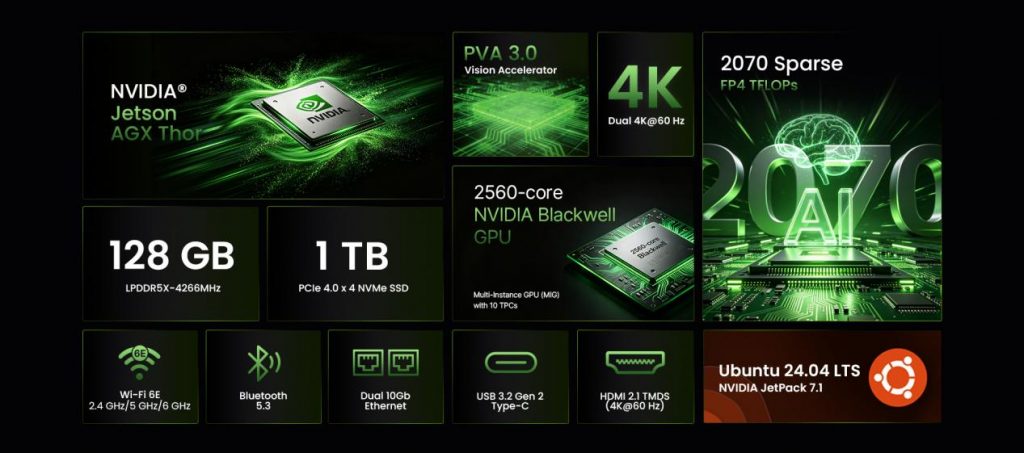
Storage and connectivity round out a professional specification set. A 1TB PCIe 4.0 NVMe M.2 SSD comes standard with upgrade options up to 4TB. Network capabilities include dual 10GbE Ethernet for ultra-fast wired connectivity and Wi-Fi 6E plus Bluetooth 5.3 for wireless flexibility. Video output supports dual high-resolution displays via two HDMI 2.1 TMDS ports at 4K@60Hz, and peripheral connectivity includes four USB 3.2 Gen 1 Type-A ports plus one USB 3.2 Gen 2 Type-C.
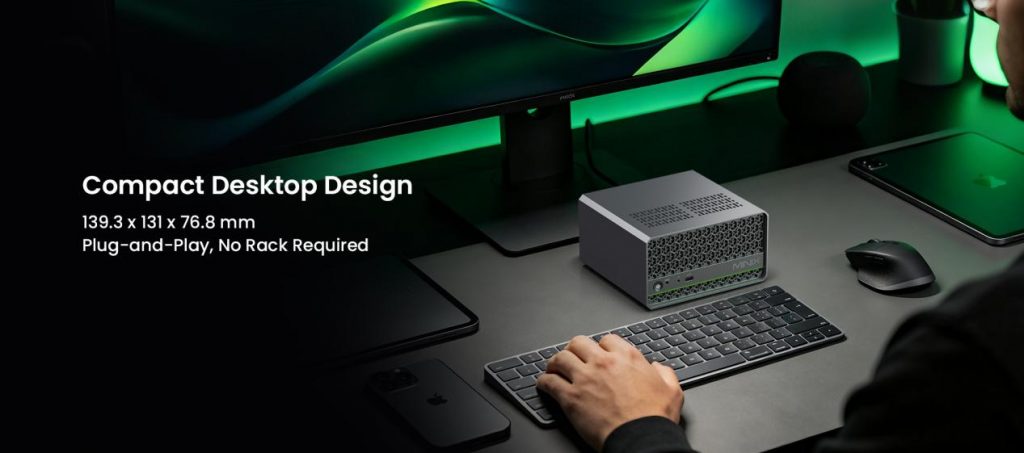
The compact dimensions of 139.3 × 131 × 76.8 mm and lightweight 1420g chassis mean these workstations fit easily on a desk without requiring dedicated rack space or tower cases. A twin turbo intercooler manages thermal performance during sustained high-load operation.
On-Premise AI and Security
Security and privacy considerations drive the on-premise design philosophy. All data and models remain on the device with no cloud upload required — addressing a primary concern for enterprises handling sensitive information in regulated industries. This approach enables private AI deployments where data residency requirements prohibit external processing.
The software environment includes Ubuntu 24.04 LTS pre-installed with NVIDIA JetPack 7.1, providing full support for CUDA, TensorRT, NIM, and containerized AI workflows. This standardized Linux environment ensures compatibility with existing AI development pipelines and container orchestration tools.
Industrial-grade reliability features include a 255-level programmable watchdog timer and ESD immunity Grade 4 rating, along with wide environmental tolerance for deployment in varied conditions. These specifications suggest MINIX designed for deployment scenarios beyond typical office environments.
Ideal Use Cases
The T4000 and T5000 target four primary workload categories:
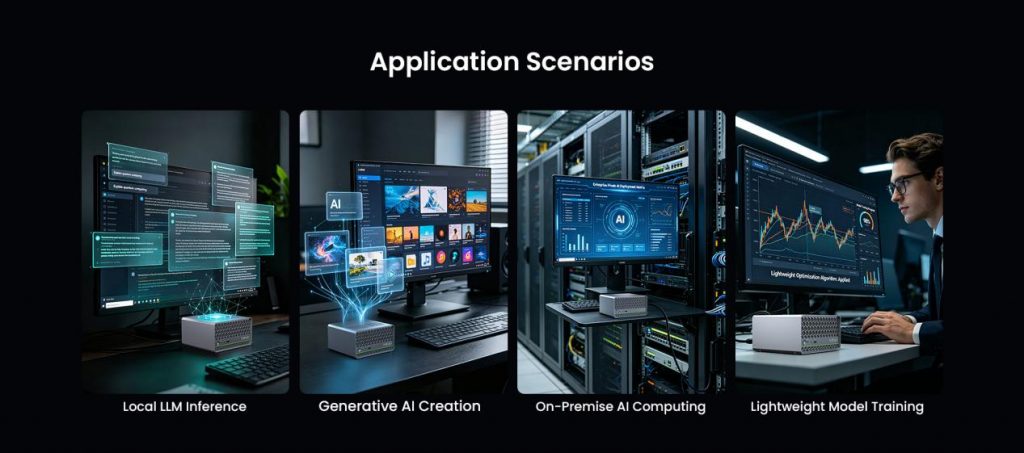
Local LLM Inference — Private, low-latency AI chat, reasoning, and document processing for businesses that cannot send sensitive data to external APIs. Healthcare, legal, and financial services firms with strict data handling requirements represent obvious markets.
Generative AI Creation — AI image, video, 3D, and digital content production for creators who need reliable local processing without per-image or per-generation costs. Studios and individual creators producing high volumes of AI-assisted content benefit from predictable hardware costs rather than variable API pricing.
On-Premise AI Computing — Enterprise private AI hub deployment enabling secure team AI services without internet connectivity requirements. Research organizations and government agencies with classified workloads gain a deployment path that maintains security boundaries.
Lightweight Model Training — LoRA fine-tuning, model distillation, and dataset processing for teams customizing base models for specific domains. The memory capacity and compute headroom support iterative training workflows without cloud resource dependencies.
Market Context
The compact AI workstation segment has grown increasingly active as enterprises seek alternatives to cloud AI services. Rising API costs, data privacy concerns, and latency requirements for real-time applications have made on-premise AI infrastructure attractive across market segments.
MINIX positions the T4000 and T5000 against solutions from companies like Lambda Labs, CoreWeave, and traditional workstation vendors who have introduced AI-focused configurations. The compact form factor differentiates from traditional tower workstations, while the NVIDIA Jetson platform provides a balance of performance and power efficiency that rack-mount servers cannot match for office deployment.
Our Take
The MINIX T4000 and T5000 arrive at an inflection point in enterprise AI adoption. Organizations that aggressively adopted cloud AI services over the past two years are now grappling with predictable cost management and data governance challenges. The shift toward private deployment options reflects maturing AI strategy rather than rejection of AI — companies want AI capabilities without surrendering control over their data.
The 70B parameter support is particularly significant for Malaysian enterprises. Local financial institutions, healthcare providers, and government agencies face data localization requirements that make cloud AI services impractical. A compact workstation capable of running large language models locally removes the architectural barrier that forced either cloud compromise or AI abandonment.
For creative professionals and smaller businesses, the T4000 and T5000 represent a different calculation — deterministic hardware costs versus variable API subscription fees. Studios producing consistent AI content volumes can amortize hardware purchases while eliminating per-generation pricing that scales unpredictably with usage.
The Blackwell architecture’s energy efficiency improvements also matter for Malaysian deployment. Office cooling costs and power distribution constraints in older commercial buildings can limit data center expansion. Compact workstations with improved performance-per-watt ratings sidestep these infrastructure challenges more easily than traditional server deployments.
Pricing will determine whether these workstations serve mainstream professional markets or remain specialist tools. The capabilities are compelling; the commercial viability depends on how MINIX positions the T4000 and T5000 against more established workstation options from Dell, HP, and Lenovo who serve similar professional markets with broader support networks.