

Eppendorf to Invest RM180m in First Southeast Asian Manufacturing Plant in Penang

TLDR
- German life sciences company Eppendorf will pour EUR 40 million (about RM180 million) into its first Southeast Asian manufacturing plant, anchored in Penang.
- The facility forms part of Eppendorf’s strategy to diversify production beyond its Hamburg headquarters and serve fast-growing APAC biotech demand from a regional base.
- Penang’s existing medical-device and lab-instrument ecosystem — spanning Plexus, Globetronics and a deep contract-manufacturing supplier base — made it the obvious site.
- The investment lands weeks after AIXTRON’s Penang compound-semiconductor facility, reinforcing the state’s pull as a magnet for high-precision industrial investment.
- Construction is expected to start in 2026, with first production output targeted for 2027 and several hundred engineering and technical jobs to follow.
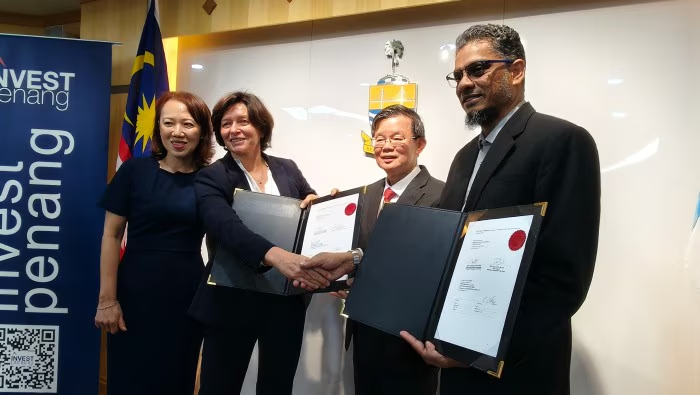
German life sciences group Eppendorf has signed a long-term lease for its first Southeast Asian manufacturing site, committing roughly EUR 40 million (around RM180 million) to a greenfield plant in Penang. The move marks the Hamburg-headquartered lab-instrument maker’s biggest production investment outside Europe and signals a clear bet on Malaysia as the regional hub for premium lab consumables, bioreactors and liquid-handling devices.
The facility will produce pipettes, pipette tips, tubes, plates and a range of cell-handling consumables that ship into pharmaceutical, diagnostics and academic laboratories across Asia-Pacific. By manufacturing closer to customers, Eppendorf expects to shorten lead times for Southeast Asian and Oceanian clients that today rely entirely on shipments out of Germany.
State investment agency InvestPenang has been courting Eppendorf for more than two years as part of a deliberate pivot into life-sciences manufacturing, complementing the state’s dominant electrical-and-electronics base. The choice is also a vote of confidence in Malaysia’s medical-device regulatory framework, which is recognised by regulators in the European Union, Japan and Australia — critical for a supplier whose products land in regulated labs.
Why Penang, and Why Now
Penang has spent four decades building deep capability in high-mix, high-precision assembly — the kind of work that demands tight tolerances, clean-room discipline and engineers who understand injection-mould tooling. Eppendorf’s consumables lines fit that profile almost exactly. The state already houses more than 350 multinational manufacturers including Bosch, Western Digital, Intel, Broadcom and B. Braun, and the supplier base for precision plastics, moulded optics and automation cells is among the densest in Southeast Asia.
Local demand is also part of the pull. Malaysia’s contract-research sector, anchored by the Clinical Research Malaysia network and a growing pool of biotech startups in Cyberjaya and Bukit Jalil, imports the vast majority of its pipette tips and culture-ware from European suppliers. Bringing that production onshore is expected to reduce landed costs for Malaysian labs by 15–25%, according to industry estimates, and to make Eppendorf’s catalogue more accessible to mid-tier university labs that today buy on price.
Construction is scheduled to begin before the end of 2026, with first production runs pencilled in for 2027. Once ramped, the plant is expected to employ several hundred people across engineering, quality assurance, automation and supply-chain roles, with Eppendorf confirming it will run the facility under its own quality system rather than outsourcing to a contract manufacturer.
Our Take
Eppendorf’s RM180 million bet is a quieter but more strategically interesting story than the headline-grabbing AI data-centre builds dominating this year’s news cycle. Life-sciences manufacturing is sticky: once a lab standard is locked in, it tends to stay locked in for a decade. By producing consumables in Penang, Eppendorf is positioning itself as the regional default rather than a distant European supplier — and that gives it a real advantage as Southeast Asia’s biotech sector scales through the late 2020s.
For Malaysia, the deal slots neatly into the New Industrial Master Plan 2030, which calls for a thicker base of mid-tech, high-precision manufacturing rather than just more back-end semiconductor packaging. The bigger story, though, is what comes next: every global life-sciences supplier that visits Eppendorf’s Penang line will see a functioning ecosystem that can be replicated. Expect more German, Swiss and American medtech names to follow within 18 months.






[…] 📖 Baca versi English: Eppendorf to Invest RM180m in First Southeast Asian Manufacturing Plant in Penang […]