


Sony Confirms AI-Powered Frame Generation Is Coming to PlayStation — Here’s What That Means for Gamers

TLDR:

- Sony PlayStation lead architect Mark Cerny confirms AI frame generation is in development for PlayStation consoles
- Project Amethyst is Sony’s joint effort with AMD to bring AI-powered graphics to PlayStation hardware
- AMD’s upcoming FSR Redstone suite provides the foundation — delivering upscaling, frame generation, and ray reconstruction
- The feature is not coming this year but could appear as early as next year
- Malaysian gamers with PS5 and PS5 Pro will benefit most from smoother frame rates without hardware upgrades
Why Frame Generation Matters for PlayStation Gamers

If you have been gaming on a PlayStation 5, you have probably noticed that some titles run at higher resolutions but lower frame rates, while others prioritize frames but drop the resolution. The tension between visual fidelity and smooth gameplay has been a constant tradeoff — until now. Sony’s lead system architect Mark Cerny has confirmed that AI-powered frame generation is actively in development for PlayStation, promising a future where you do not have to choose between pretty graphics and buttery-smooth performance.
Frame generation is a technique where an AI algorithm generates additional frames between rendered frames, effectively boosting the perceived frame rate without requiring the game console to do all the rendering work. It is the same technology that Nvidia’s DLSS Frame Generation brought to PC gaming, and AMD has been implementing its own version through FSR (FidelityFX Super Resolution) on both PC and consoles. Sony is now bringing that capability directly into the PlayStation ecosystem through Project Amethyst.
Project Amethyst — Sony and AMD’s Joint AI Graphics Push
Project Amethyst is Sony’s internal name for the graphics machine learning initiative it is building in close partnership with AMD. The project is specifically tuned for PlayStation’s custom hardware — the same AMD RDNA-based architecture that powers the PS5 and PS5 Pro. Rather than a one-size-fits-all solution, Sony is working with AMD to optimize the AI models for the specific capabilities of PlayStation silicon.
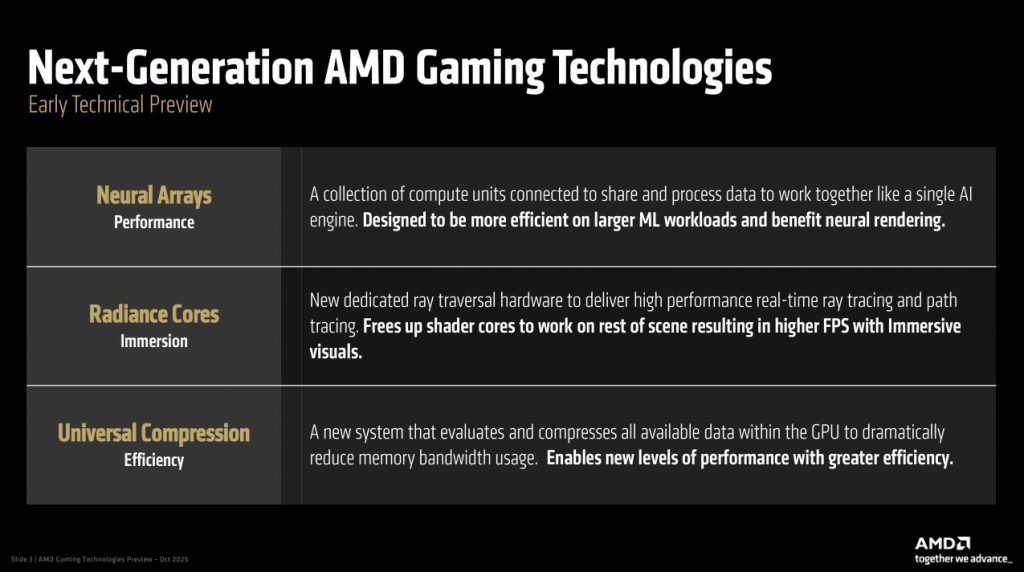
The foundation for Project Amethyst rests on AMD’s forthcoming FSR Redstone suite. FSR Redstone is AMD’s next generation of its spatial upscaling and frame generation technology, and it brings three key capabilities: upscaling (rendering at a lower resolution and intelligently scaling up), frame generation (creating intermediate frames between rendered ones), and ray reconstruction (AI-assisted ray tracing). For PlayStation users, the frame generation piece is the headline — it is what turns a 30fps game into something that feels like 60fps, or a 60fps game into something approaching 120fps.

Cerny noted that PlayStation’s existing Spectral Super Resolution feature already shares architectural DNA with FSR Redstone. Spectral Super Resolution is Sony’s current answer to AMD FSR and Nvidia DLSS — it handles upscaling intelligently but does not generate intermediate frames. Project Amethyst is effectively the next step: not a completely new technology but a significant evolution of what is already running on PlayStation consoles today.
When Will Malaysian Gamers See This?
Mark Cerny was measured in his timeline expectations, stating the feature is not coming within this year. That is a realistic assessment — Sony typically does not announce features until they are close to ready, and Cerny’s public comments tend to be conservative. The more optimistic reading is that we could see a preview or beta implementation sometime next year, potentially aligned with a major software update to the PlayStation 5 system software or tied to new game launches that specifically leverage the new capability.
For Malaysian PlayStation owners, the impact could be significant. The PS5 has been a strong seller in Malaysia since its launch, and the PS5 Pro — which launched at a premium price point — has found a audience among serious gamers who want the best possible performance. If frame generation arrives via a software update, PS5 Pro owners in particular could see their existing hardware become even more capable without spending additional money. That is a meaningful value proposition in a market where every ringgit counts.
The more interesting question is how developers will adopt the technology. Frame generation works best when developers specifically design for it, and the quality of implementation varies depending on how deeply it is integrated into a game’s rendering pipeline. Sony will need to make the development tools accessible enough that first-party studios like Naughty Dog, Insomniac, and Santa Monica Studio can leverage Project Amethyst in their upcoming titles. If the implementation is as smooth as what we have seen on PC with DLSS Frame Generation, it could be a genuine game-changer for PlayStation exclusives that have historically prioritized visual quality over raw frame rate.
Our Take
Sony confirming AI frame generation for PlayStation feels like inevitability arriving a little late — PC gamers have had DLSS Frame Generation for years, and AMD’s FSR has been on the scene for almost as long. But the difference is that Sony is not simply porting a PC solution. Project Amethyst is being built specifically for PlayStation hardware, which means it can be optimized in ways that a general-purpose PC solution cannot. The fact that Cerny is comfortable publicly discussing it — even with a conservative timeline — suggests the engineering work is further along than the careful wording lets on.
For Malaysian PS5 owners, this is good news regardless of when it arrives. The PS5 installed base in Malaysia is substantial, and any software improvement that makes games look and feel better without requiring new hardware is a win. The PS5 Pro, in particular, would benefit enormously from frame generation — it already has the raw horsepower to run games at high visual fidelity, and adding AI-generated frames on top of that could deliver an experience that approaches or matches what we expect from PC gaming at equivalent price points.
The bigger picture is that AI-assisted graphics are no longer a novelty or a niche feature for enthusiasts. They are becoming a standard part of how console hardware delivers improved experiences over time. Sony’s move here mirrors what Microsoft has been doing with its Auto Super Resolution feature on Xbox. The console wars may be fought on hardware specs, but the real differentiator in this generation is increasingly software intelligence. When that frame generation feature finally arrives on your PS5, the upgrade will feel free — even though you paid for the console years ago.