

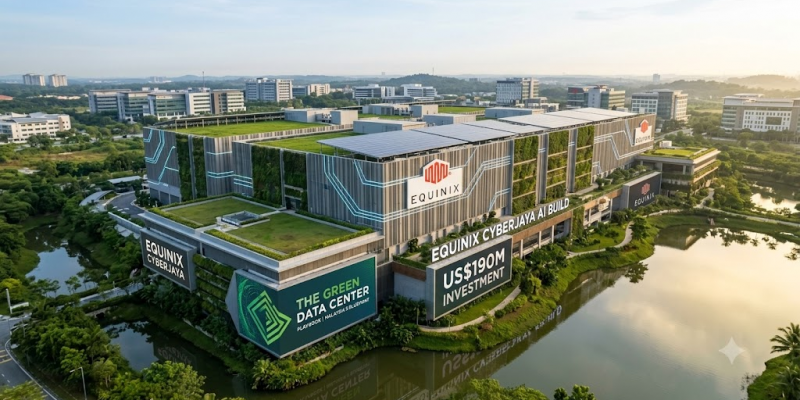
Equinix Bets US$190M on Cyberjaya AI Build While Pitching Malaysia as a Green Data Center Playbook

TLDR
- CRN Asia spotlights Equinix’s Malaysia playbook for keeping AI-hungry data centers green amid surging capacity builds
- Equinix is committing US$190 million to its fourth Malaysian facility in Cyberjaya, on top of KL1, KL2 and JH1 already online
- Globally, Equinix hit 96% renewable energy coverage across its portfolio in 2025, targeting 100% by 2030
- Named a Leader in the IDC MarketScape 2025-2026 Worldwide Datacenter Services Sustainability Vendor Assessment
- Heat-recovery pilots in Europe already export 19 GWh annually — Malaysia could be next if district-heating partnerships materialise
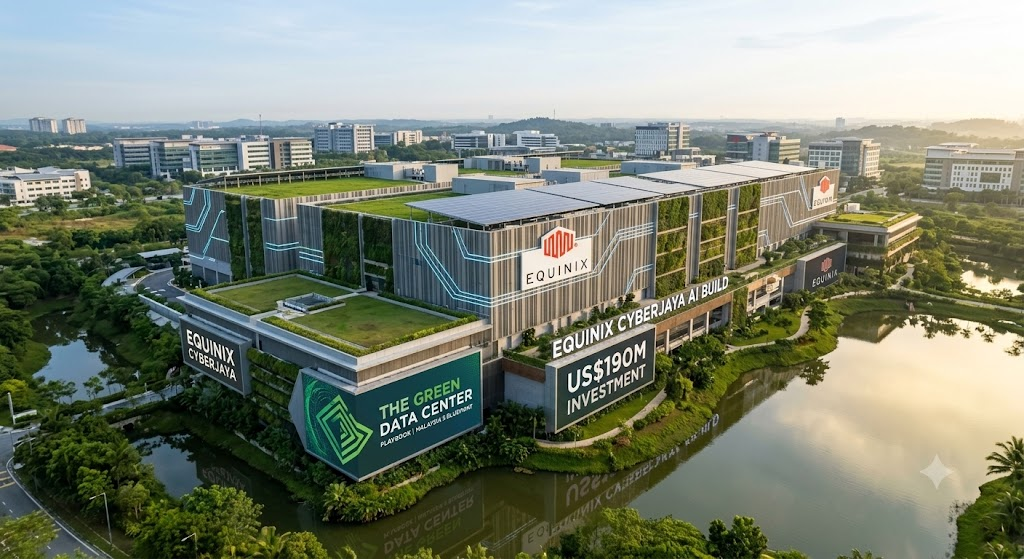
Equinix is walking a tightrope in Malaysia. The US-listed colocation giant is pouring capital into new AI-ready facilities at the same time regulators, activists, and hyperscaler customers are asking harder questions about how much energy and water those sites consume. CRN Asia’s July deep-dive on Equinix’s Malaysia data center strategy lays out how it is trying to square that circle.

Malaysia has become one of Equinix’s most strategic Asia-Pacific markets. The company already runs KL1 in Cyberjaya, KL2 in Kuala Lumpur, and JH1 in Johor — three sites that together carry the bulk of its Malaysian interconnection traffic. The fourth site, a US$190 million build also in Cyberjaya, was greenlit earlier this year and is designed for higher-density AI workloads, including liquid-cooled racks.
The Green Numbers Behind the Build
Equinix’s pitch is that Malaysian expansion doesn’t have to come at the expense of its sustainability targets. Globally, the company reported 96% renewable energy coverage across its portfolio in 2025 and is committed to 100% by 2030. It also disclosed a 5.3% year-over-year improvement in power usage effectiveness (PUE), backed by US$36 million in efficiency capex.
Those numbers matter for Malaysia because Tenaga Nasional Berhad’s grid is still coal-heavy, and hyperscaler customers grade suppliers on whether MY-region megawatt-hours are matched by new renewable generation. Equinix’s December 2025 designation as a Leader in the IDC MarketScape Worldwide Datacenter Services Sustainability Vendor Assessment is the third-party validation it is leaning on.
Heat Reuse Is the Differentiator
The more interesting part of Equinix’s sustainability playbook isn’t the renewable-energy scoreboard — it’s heat export. The company has been exporting residual heat from its data centers since 2010 at its Helsinki site. In 2025, that program moved 19 GWh of thermal energy into local heating networks, including the Olympic Aquatics Centre pool in Paris.
Equinix announced a partnership with Italian energy group A2A to recover up to 225 GWh per year from its Settimo Milanese campus — enough to heat more than 21,000 homes and avoid 345,000 tonnes of CO₂ annually. The model requires a municipal district-heating network, which Malaysia currently lacks. With the government pushing district-cooling pilots, a Malaysian heat-recovery partnership is a near-term possibility.
The Local Pushback Context
This announcement lands against a real local backdrop. Earlier this year, Malaysia saw its first public protest against data center water and pollution impacts. For Equinix, a green narrative is becoming a precondition for the next phase of MY permits. The company’s Asia-Pacific president Cyrus Adaggra has framed AI inference as a metro-edge problem — workloads that need to live close to where data is generated and consumed. That’s why KL2, JH1, and the Cyberjaya build all sit inside dense Malaysian cities rather than cheaper rural land.
Our Take
Let’s be honest about what an IDC MarketScape Leader designation actually is: a vendor-friendly analyst report that Equinix will quote in customer decks. That doesn’t make the underlying numbers fake — 96% renewable coverage and a 5.3% PUE improvement are real — but the framing should be read with the usual corporate-skeptic filter.
The genuine question is whether the Malaysian build-out — four sites, rising AI density, a Cyberjaya community that just learned what a data center is — can stay ahead of its own growth curve. A 96% global renewable figure looks great on a slide, but if the Cyberjaya 4 site locks in coal-heavy grid power for its first three years, the local impact story is harder to sell. We want site-level MY renewable mix, not just global blended numbers, before the next Malaysian ribbon-cutting.
The heat-export angle is the genuinely interesting part. If Equinix can find a Malaysian partner willing to host a heat-recovery loop — and the Ministry of Investment’s district-cooling initiatives make that a realistic ask — Malaysia could become a regional showcase for the next phase of data center decarbonization. Until then, this is a credible green build in progress, not a finished sustainability story.
Keyword: Equinix Malaysia green data center strategy
Source
- CRN Asia — Building green in the age of AI: Equinix’s Malaysia data center strategy
- Equinix Newsroom — Press Releases & Company Updates
- Equinix Blog — Could Data Centers Be the Low-Carbon Heat Source That Communities Need?
- Equinix — IDC MarketScape 2025-2026: Datacenter Services Sustainability Vendor Assessment





[…] 📖 Baca versi English: Equinix Bets US$190M on Cyberjaya AI Build While Pitching Malaysia as a Green Data Center Playbook […]